Building Topical Authority Fast: The AI-Accelerated Approach
Learn how to build topical authority 10x faster using AI-powered content clusters. Complete guide to establishing expertise and dominating search rankings.
Jump to section
The SEO playbook has changed. Chasing individual keywords and building backlinks isn’t enough anymore. In 2026, Google’s AI-powered algorithms prioritize one thing above all: topical authority.
If you’re not recognized as a comprehensive expert on your subject, you’re invisible. But here’s the game-changer: building topical authority used to take 12-18 months. With AI acceleration, you can establish meaningful authority in 6-8 weeks.
This guide shows you exactly how. For insights on making AI content rank, see our guide on AI SEO content: how to rank in 2026.
What Is Topical Authority (And Why It Matters)
Topical authority is how search engines measure your expertise on a specific subject. It’s not about ranking for one keyword—it’s about owning the entire conversation around a topic.
According to Shopify’s 2026 SEO guide, topical authority means “consistently creating and linking high-quality content relevant to a specific subject or niche.” When Google sees you’ve comprehensively covered every angle of a topic, it trusts you as the authoritative source.
Why Traditional SEO Is Dead
Nearly 60% of searches now end without a click, with users getting answers directly from AI Overviews at the top of search results. The old playbook of chasing high-volume keywords and backlinks is obsolete.
Search Engine Land explains it perfectly: “Search engines favor sites that demonstrate comprehensive topical coverage. Content clusters show search engines you’re an authority on a subject by covering it from multiple angles.”
Topical Authority vs. Domain Authority
Many people confuse these concepts. Here’s the difference:
| Aspect | Domain Authority | Topical Authority |
|---|---|---|
| What it measures | Overall site strength | Expertise on specific topics |
| Based on | Backlink profile | Content depth and coverage |
| Scope | Entire website | Specific subject areas |
| Metric type | Third-party tool (Moz) | Search engine evaluation |
| Time to build | Months to years | Weeks to months (with AI) |
| Primary signal | External validation | Content comprehensiveness |
Domain authority helps, but topical authority wins rankings. You can have low domain authority and still dominate search results if you’ve established clear topical expertise.
The E-E-A-T Connection
Topical authority directly aligns with Google’s E-E-A-T framework:
- Experience: First-hand knowledge demonstrated through case studies and examples
- Expertise: Comprehensive topic coverage proving deep understanding
- Authoritativeness: Recognition as a go-to resource (external citations, mentions)
- Trustworthiness: Consistent quality and accuracy across all content
As Kopp Online Marketing’s research shows, Google uses over 80 indirect signals to evaluate E-E-A-T. Topical authority is one of the strongest signals you control entirely.
The Pillar-Cluster Model Explained
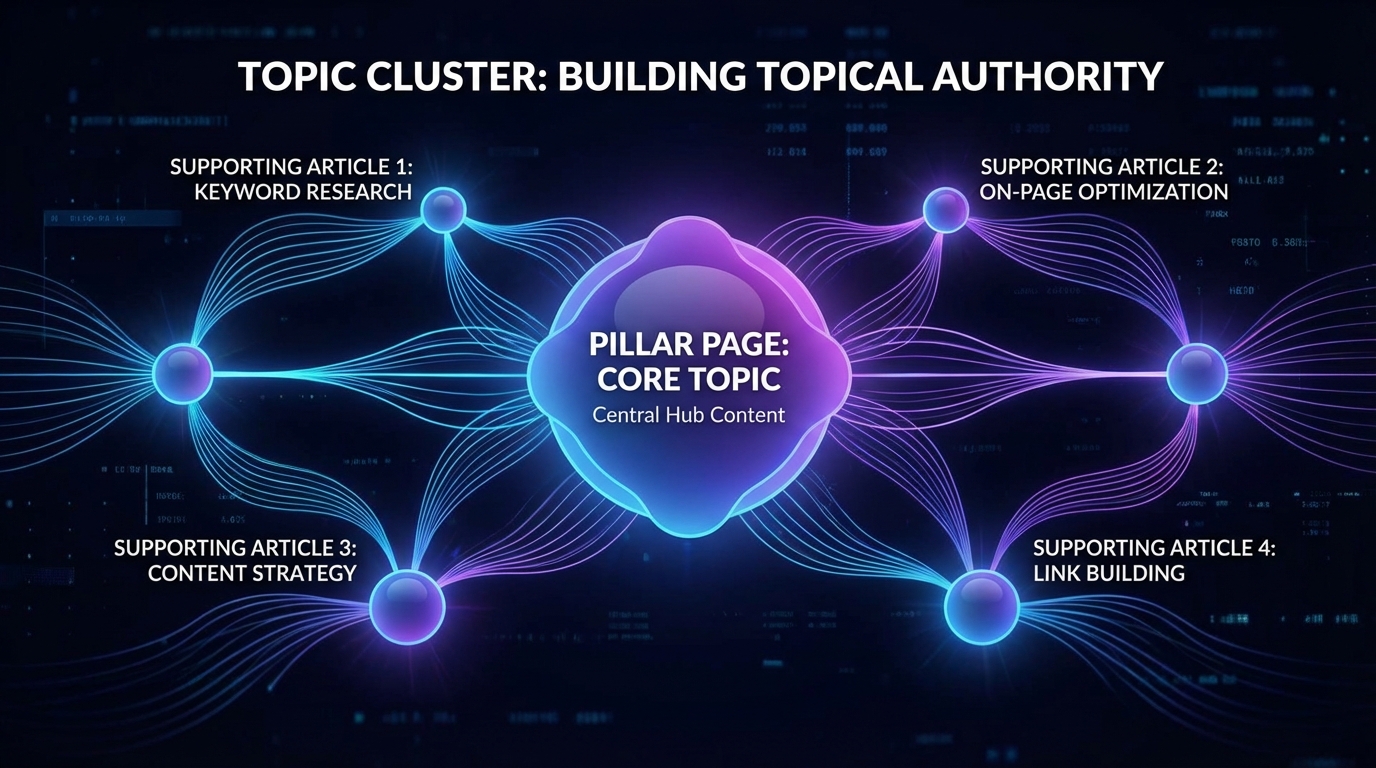
The pillar-cluster model is the proven architecture for building topical authority. It’s how you organize content to signal comprehensive expertise to search engines.
How It Works
Think of it as a hub-and-spoke system:
- Pillar Page: A comprehensive guide (3,000-5,000 words) covering the broad topic
- Cluster Content: 20-30 supporting articles diving deep into specific subtopics
- Internal Links: All cluster articles link back to the pillar, creating a semantic web
Clearscope’s guide explains: “The pillar page covers the topic broadly, while supporting articles dive deep into specific subtopics. All supporting articles link back to the pillar page, creating a web of related content that signals topical expertise to search engines.”
Anatomy of a Perfect Pillar Page
Your pillar page is the foundation. Here’s what it needs:
Structure:
- Comprehensive overview covering all major subtopics
- 3,000-5,000 words of in-depth content
- Clear sections with descriptive H2/H3 headings
- Table of contents for navigation
- Internal links to all cluster articles
Content Requirements:
- Answers the broad topic comprehensively
- Includes semantic keywords naturally
- Provides unique value (not rehashed basics)
- Features data, examples, and visual aids
- Establishes author expertise and credentials
SEO Optimization:
- Target your primary keyword in title, URL, H1
- Include LSI and semantic variations throughout
- Optimize meta description for click-through
- Add schema markup (Article or HowTo)
- Ensure fast loading and mobile-friendly design
Planning Your Cluster Content
According to Semrush’s topical authority guide, effective cluster content requires both breadth and depth:
Breadth: Cover 20-30 related subtopics within your niche Depth: Each cluster article should be 1,500-2,500 words with comprehensive analysis
Here’s how to identify cluster topics:
- Keyword Research: Find long-tail variations of your main topic
- Question Analysis: Use “People Also Ask” and forums to find pain points
- Competitor Gap Analysis: See what topics competitors haven’t covered
- Search Intent Mapping: Address informational, commercial, and transactional intent
Go Fish Digital recommends mapping out 15-25 supporting articles covering different aspects of the pillar topic, then creating a publishing timeline that spreads content creation over 3-6 months.
The Power of Internal Linking
Internal linking is what transforms individual articles into a topical authority asset. It tells search engines how your content pieces relate to each other.
Best Practices:
- Link every cluster article to the pillar page (using descriptive anchor text)
- Cross-link related cluster articles when relevant
- Use 3-5 internal links per article minimum
- Vary anchor text but keep it descriptive
- Link from high-authority pages to newer content
Gravitate Design explains: “A strong internal linking strategy helps search engines understand relationships between pages, signaling how individual pieces fit into your broader topic ecosystem.”
Build Your Content Cluster in Minutes
Suparank's AI generates complete topical maps with pillar pages and 20+ cluster articles. Start building authority today.
How AI Accelerates Authority Building
Here’s the truth: manually creating 20-30 comprehensive articles takes 6-12 months. With AI, you can do it in 6-8 weeks while maintaining quality.
But there’s a catch. AI-generated content alone won’t build authority. You need the right approach. For a deep dive into what makes AI content actually rank, check out our guide on AI SEO content: how to rank in 2026.
The AI-Human Collaboration Model
The HOTH’s AI topical authority guide outlines the winning formula:
AI Handles:
- Topic research and keyword clustering
- Content structure and outlines
- First drafts and semantic optimization
- Internal linking suggestions
- Competitive analysis
Humans Add:
- First-hand experience and case studies
- Proprietary data and insights
- Expert analysis and unique perspectives
- Brand voice and personality
- E-E-A-T signals (credentials, citations)
This collaboration lets you produce content 10x faster without sacrificing the expertise signals Google demands.
AI Tools That Actually Work
The AI content landscape is crowded, but these tools specifically excel at building topical authority:
Topical Map Generation:
- Topical Map AI: Generates complete content clusters in 5 minutes
- HackTheSEO Topical Map Generator: Creates comprehensive keyword hierarchies with search intent data
- SEO.ai Topic Cluster Tool: Free keyword clustering with no login required
Content Creation & Optimization:
- Suparank: End-to-end MCP platform for AI-powered SEO content workflows
- Clearscope: AI-powered content optimization with topical relevance scoring
- Surfer SEO: Real-time content editor with semantic keyword suggestions
- Frase.io: AI-based topic research and content brief generation
Internal Linking:
- Link Whisper: Automatic internal linking suggestions using AI analysis
- Suparank Internal Links Tool: Strategic linking recommendations for authority building
Globe Runner’s analysis shows that “AI tools are revolutionizing how content marketers build topical authority through automated keyword clustering, content generation, and internal linking—dramatically reducing the time from weeks to minutes.”
The 5-Phase AI Acceleration Framework
Here’s the exact process we use at Suparank to build topical authority in 6-8 weeks:
Phase 1: Strategic Planning (Week 1)
- Define your niche and target audience
- Research primary and semantic keywords
- Map competitor topical coverage
- Generate topical map with AI tools
- Create content calendar for 20-30 articles
Phase 2: Pillar Creation (Week 1-2)
- AI generates comprehensive outline
- Human adds expertise and unique insights
- Optimize for primary keyword and semantics
- Add E-E-A-T signals (author bio, citations)
- Publish and promote pillar page
Phase 3: Cluster Production (Weeks 2-6)
- AI drafts 3-5 cluster articles per week
- Humans inject experience and data
- Optimize each for target subtopic keywords
- Implement internal linking strategy
- Publish consistently on schedule (learn how to scale blog content as a solo founder without burning out)
Phase 4: Optimization (Weeks 6-7)
- Add schema markup to all articles
- Strengthen internal linking network
- Update pillar page with cluster links
- Optimize for GEO (Generative Engine Optimization)
- Ensure mobile performance and UX
Phase 5: Measurement & Iteration (Week 8+)
- Monitor topical authority scores
- Track keyword ranking improvements
- Identify content gaps
- Create additional cluster content
- Refresh and update existing articles
Maintaining Quality with AI Content
Chapters EG’s 2026 authority guide emphasizes: “Quality always outweighs quantity—focus on producing comprehensive, well-structured content that dives deep into questions your audience is asking.”
Quality Checklist for AI-Generated Content:
- Includes first-person experience or case studies
- Cites authoritative sources and data
- Provides unique insights not found elsewhere
- Features clear author credentials and bio
- Passes plagiarism detection tools
- Reads naturally (not robotic or repetitive)
- Answers user intent comprehensively
- Includes visual aids (images, charts, tables)
- Optimized for readability (short paragraphs, bullets)
- Contains actionable takeaways
Step-by-Step Implementation Guide
Let’s walk through building topical authority from scratch. This is the exact process that works in 2026.
Step 1: Choose Your Niche (The Right Way)
Your niche determines everything. Too broad, and you’ll never establish authority. Too narrow, and you won’t have enough search demand.
The Goldilocks Criteria:
- Specific enough to dominate (not “marketing” but “B2B SaaS content marketing”)
- Broad enough for 30+ subtopics (sufficient cluster content opportunities)
- Aligned with your expertise (you have first-hand knowledge)
- Commercial intent exists (people will pay for solutions)
- Competition is beatable (not dominated by legacy brands)
How to Validate Your Niche:
- Search your main topic on Google
- Check “People Also Ask” and related searches
- Count potential subtopics (aim for 30+)
- Analyze top 10 competitors for content gaps
- Verify search volume for primary keywords (1,000-10,000/month is ideal)
Step 2: Conduct Comprehensive Topic Research
Intuitive Digital’s authority-building guide recommends starting by “understanding your audience’s full landscape of questions, pain points, and related subtopics.”
Research Process:
Keyword Clustering:
- Use Ahrefs, Semrush, or SEO.ai’s clustering tool
- Identify primary keyword and 100+ semantic variations
- Group keywords into 20-30 thematic clusters
- Assign search intent to each cluster (informational/commercial/transactional)
Competitor Analysis:
- Identify top 5 competitors ranking for your main topic
- Audit their content structure (pillar pages, cluster articles)
- Map their topical coverage using tools like Screaming Frog
- Identify gaps and opportunities they’ve missed
Question Mining:
- Export questions from AnswerThePublic and AlsoAsked
- Analyze Reddit, Quora, and industry forums
- Review comments on competitor articles
- Use BuzzSumo to find trending discussions
Intent Mapping:
- Categorize topics by search intent
- Ensure coverage of all funnel stages (awareness → decision)
- Balance informational content (80%) with commercial content (20%)
Step 3: Create Your Topical Map
A topical map is your content blueprint. It visualizes how your pillar and cluster articles connect.
Manual Method:
- Place pillar topic in center
- Branch out 20-30 cluster topics
- Draw connections showing internal links
- Add keyword targets to each node
- Prioritize by search volume and difficulty
AI-Accelerated Method: Use tools like Topical Map AI or Suparank’s topical mapping tool:
- Input your main keyword
- AI generates complete hierarchy
- Review and refine suggestions
- Export as content calendar
- Assign creation priorities
Torro’s authority guide recommends creating exactly 20 strategic articles: “This provides enough depth and breadth to signal expertise to search engines without overwhelming your content production capacity.”
Step 4: Build Your Pillar Page
Your pillar page is the cornerstone. Invest the most effort here.
Pillar Page Template:
-
Introduction (300-400 words)
- Hook with a bold statement or statistic
- Define the topic comprehensively
- State what readers will learn
- Establish your expertise (credentials, experience)
-
Table of Contents
- Link to each major section
- Include estimated reading time
- Enable jump navigation
-
Core Content Sections (2,500-4,000 words)
- Cover 5-8 major subtopics
- Each section = 400-600 words
- Include data, examples, and visuals
- Link to relevant cluster articles (when published)
-
Conclusion (200-300 words)
- Summarize key takeaways
- Include clear call-to-action
- Link to starter cluster articles
-
FAQ Section
- Answer 5-10 common questions
- Optimize for featured snippets
- Add FAQ schema markup
Step 5: Execute Cluster Content Production
With your pillar published, it’s time to build supporting content.
Production Workflow:
Week 1-2:
- Create pillar page
- Publish 3-4 foundational cluster articles
- Focus on high-volume, informational topics
Week 3-4:
- Publish 3-5 cluster articles per week
- Start internal linking to pillar page
- Cross-link related cluster articles
Week 5-6:
- Maintain 3-5 articles per week pace
- Update pillar page with new cluster links
- Strengthen internal linking network
Week 7-8:
- Complete remaining cluster content
- Optimize all articles for GEO
- Add schema markup across cluster
Quality Standards Per Cluster Article:
- 1,500-2,500 words (comprehensive but focused)
- Target 1 primary keyword + 5-10 semantic variations
- Include 3-5 internal links (1 to pillar, 2-4 to related clusters)
- Add unique data or first-hand insights
- Optimize for featured snippets
- Include visual aids (images, charts, screenshots)
Automate Your Cluster Production
Suparank handles research, writing, and optimization for entire content clusters. Ship 20+ articles in weeks, not months.
Step 6: Implement Strategic Internal Linking
Internal linking is what transforms disconnected articles into a topical authority powerhouse.
Linking Strategy:
Pillar → Cluster Links:
- Link from pillar page to every cluster article
- Use descriptive anchor text with target keywords
- Place links contextually within relevant sections
Cluster → Pillar Links:
- Every cluster article links back to pillar (typically in introduction or conclusion)
- Use variations like “complete guide,” “comprehensive overview,” “main resource”
Cluster → Cluster Links:
- Cross-link related cluster articles
- Use contextual anchor text
- Aim for 2-4 cluster-to-cluster links per article
Best Practices:
- Use descriptive anchor text (not “click here” or “read more”)
- Link to relevant sections within articles (deep linking)
- Open external links in new tabs, internal links in same tab
- Update older articles with links to newer content
Step 7: Optimize for Generative Engine Optimization (GEO)
In 2026, AI search engines (ChatGPT, Perplexity, Google SGE) drive significant traffic. GEO optimization ensures your content appears in AI-generated answers.
GEO Optimization Checklist:
- Use clear, structured headings (H2/H3) for easy parsing
- Include concise definitions and summaries
- Add FAQ sections with direct answers
- Cite authoritative sources with proper attribution
- Use schema markup (Article, HowTo, FAQ)
- Create comprehensive, factual content (AI trusts depth)
- Include statistics with source citations
- Optimize for question-based queries
- Maintain consistent brand voice across cluster
Step 8: Measure and Iterate
Topical authority isn’t set-it-and-forget-it. You need to measure progress and continuously improve.
Key Metrics to Track:
| Metric | What It Measures | Target |
|---|---|---|
| Topical Authority Score | Overall topic expertise (via SEO tools) | 70+ score |
| Keyword Rankings | Average position for target keywords | Top 10 for 70%+ |
| Organic Traffic | Visitors from search engines | 50%+ increase in 3 months |
| Internal Link Strength | Number and quality of internal links | 5+ links per article |
| Content Coverage | Percentage of subtopics covered | 80%+ coverage |
| Engagement Metrics | Time on page, bounce rate | 3+ min avg, under 50% bounce |
Tools for Measurement:
- Ahrefs/Semrush: Topical authority scores and keyword rankings
- Google Search Console: Click-through rates and impression data
- Google Analytics 4: Traffic, engagement, and conversion metrics
- Screaming Frog: Internal linking analysis
Iteration Strategy:
Month 1-2: Focus on content production and initial optimization Month 3-4: Analyze performance, identify gaps, create additional cluster content Month 5-6: Refresh underperforming articles, strengthen internal linking Month 6+: Maintain authority with quarterly content updates and new cluster additions
Common Mistakes That Kill Authority
Even with AI acceleration, these mistakes will sabotage your topical authority efforts:
1. Going Too Broad
Trying to cover “digital marketing” instead of “email marketing for e-commerce brands” means you’ll never establish expertise. Niche down ruthlessly.
Fix: Choose a specific sub-niche where you can create the most comprehensive resource on the internet.
2. Skipping the Pillar Page
Some people jump straight to cluster content. Without a pillar page, your content lacks structure and semantic cohesion.
Fix: Always start with a comprehensive pillar page that serves as your content hub.
3. Publishing Inconsistently
Creating 10 articles in one week, then nothing for a month, kills momentum with search engines.
Fix: Establish a consistent publishing schedule (3-5 articles per week) and stick to it.
4. Neglecting Internal Linking
Individual articles—no matter how good—won’t build authority without strong internal linking.
Fix: Link every cluster article to your pillar page and cross-link related cluster content.
5. Using Pure AI Content Without Expertise
AI drafts without human expertise signals won’t satisfy E-E-A-T requirements. Google will recognize the lack of unique value.
Fix: Always inject first-hand experience, proprietary data, and expert analysis into AI-generated content.
6. Ignoring Search Intent
Creating informational content for commercial intent keywords (or vice versa) means your content won’t rank, even with perfect authority signals.
Fix: Map search intent to each keyword and create content that matches user expectations.
7. Poor Content Quality
Publishing 30 thin, 500-word articles won’t build authority. Depth matters as much as breadth.
Fix: Ensure each cluster article is 1,500-2,500 words with comprehensive coverage of its subtopic.
8. Forgetting E-E-A-T Signals
AI can create great content structure, but only humans can add credentials, citations, and expertise signals.
Fix: Include author bios with credentials, cite authoritative sources, and add case studies demonstrating experience.
Timeline Expectations: What’s Realistic?
Let’s set realistic expectations for building topical authority in 2026.
Traditional Manual Approach
- Months 1-2: Research and planning, create pillar page
- Months 3-6: Produce 15-20 cluster articles
- Months 7-9: Optimize and strengthen internal linking
- Months 10-12: Start seeing meaningful rankings and authority
- Total Time: 12-18 months to establish strong authority
AI-Accelerated Approach
- Week 1: Research, topical mapping, create pillar page
- Weeks 2-6: Produce 20-30 cluster articles (4-5 per week)
- Weeks 7-8: Optimization, internal linking, GEO implementation
- Weeks 9-12: Initial ranking improvements visible
- Months 4-6: Strong topical authority established
- Total Time: 6-8 weeks to build, 3-4 months to see full results
Productive Blogging’s 2026 analysis confirms: “Building topical authority is one of the best ways to rank higher in Google’s search results and grow your website traffic in 2026—this strategy should be the centerpiece of every SEO strategy moving into 2026 and beyond.”
Factors That Accelerate Authority
- Existing domain authority: Sites with established domains see faster results
- Competitive niche: Less competitive niches achieve authority quicker
- Content quality: High E-E-A-T content ranks faster
- Publishing frequency: Consistent 3-5 articles/week builds momentum
- Internal linking strength: Strong linking accelerates authority propagation
Factors That Slow Progress
- New domain (0-6 months old): Google sandbox effect delays rankings
- Highly competitive niche: Established players dominate search
- Thin content: Low-quality articles won’t build authority
- Inconsistent publishing: Sporadic content slows momentum
- Weak internal linking: Poor linking structure limits authority signals
The Future of Topical Authority
SEO continues evolving, but topical authority’s importance is only growing. Here’s what’s coming:
AI Search Engines Prioritize Authority
SMA Marketing’s analysis shows that “AI search engines favor comprehensive topic coverage with clear structural relationships. Content clusters optimized for GEO receive preference in AI-generated responses.”
ChatGPT, Perplexity, and Google SGE cite sources with demonstrated topical expertise. Building authority now positions you for AI-driven search dominance.
Entity-Based SEO and Knowledge Graphs
Google increasingly understands entities (people, places, concepts) and their relationships. Topical authority helps Google recognize you as an entity associated with your niche.
The more comprehensive your coverage, the stronger your entity association—and the more likely Google includes you in knowledge graph results.
Video and Multimedia Authority
Techwyse reports: “YouTube is now a core SEO channel. For brands, success on YouTube is less about posting isolated videos and more about building recognizable formats, series, and topical authority that audiences return to.”
Future topical authority strategies will include video clusters complementing written content.
Increasing Complexity of E-E-A-T
Google’s quality rater guidelines continue evolving to demand higher expertise standards. Building topical authority now prepares you for increasingly strict E-E-A-T evaluation.
Take Action: Build Authority Today
Building topical authority is no longer optional—it’s the foundation of modern SEO. The good news? With AI acceleration, you can establish meaningful authority in weeks instead of months.
Here’s your action plan:
- Choose your niche (specific enough to dominate)
- Research and map topics (aim for 20-30 cluster articles)
- Create your pillar page (comprehensive 3,000-5,000 word guide)
- Execute cluster production (3-5 articles per week for 6-8 weeks)
- Implement strategic internal linking (every article connected)
- Optimize for GEO (ensure AI search engines cite your content)
- Measure and iterate (track metrics, fill gaps, refresh content)
The sites that dominate search in 2026 aren’t the ones with the most backlinks or the highest domain authority. They’re the ones recognized as comprehensive experts on specific topics.
Start building your topical authority today. Your future rankings depend on it.
Build Topical Authority 10x Faster
Suparank's AI handles research, content creation, and optimization for complete content clusters. Establish authority in weeks, not months.
Sources
- Shopify: How to Build Topical Authority To Improve Your SEO (2026)
- Semrush: What is Topical Authority? (+ How to Build It)
- Search Engine Land: Topical Authority Guide
- Clearscope: How to Build Topical Authority Like a Master SEO
- Ahrefs: What Is Topical Authority in SEO & How to Build It
- Neil Patel: Topical Authority: What It Is & How to Build It
- Gravitate Design: What Is Topical Authority in SEO (And How to Build It)
- Go Fish Digital: 5 Ways To Build Topical Authority For Your Website
- The HOTH: How AI Makes Building Topical Authority Faster and Smarter
- Globe Runner: SEO Topic Clusters in the Age of AI
- SMA Marketing: Mastering Topic Clusters for AI-Driven SEO
- HackTheSEO: SEO Topical Map Generator
- SEO.ai: Topic Cluster Tool
- Topical Map AI
- Google: Creating Helpful, Reliable, People-First Content
- Kopp Online Marketing: How Google Evaluates E-E-A-T
- Intuitive Digital: How To Build Topical Authority
- Torro: How to Build Topical Authority in SEO: 20 Articles That Work
- Chapters EG: Topical Authority: A Fresh Guide To Building It In 2026
- Productive Blogging: How to use topical authority to boost your Google rankings (2026)
- Techwyse: YouTube Is Now a Core SEO Channel
Frequently Asked Questions
How long does it take to build topical authority?
How many articles do I need for topical authority?
Can AI-generated content build topical authority?
What's the difference between topical authority and domain authority?
Tags
More articles
Best AI Content Tools for WordPress: Plugins, Integrations & Workflows
Discover the top AI content tools for WordPress in 2026, including plugins, API integrations, and complete workflows to automate content creation and SEO optimization.

AI Search Engine Ranking Factors: What Actually Matters in 2026
Discover the proven ranking factors that determine visibility across ChatGPT, Perplexity, Google SGE, and Claude in 2026. Data-backed insights from recent studies.
AI SEO Content: How to Rank with Generated Articles in 2026
Learn how AI-generated content can rank on Google in 2026. Complete guide with Google's official guidelines, E-E-A-T requirements, case studies, and optimization strategies.