How to Train AI to Match Your Brand Voice: A Step-by-Step Guide
Master AI brand voice consistency with our comprehensive framework. Learn prompt engineering techniques, tools comparison, and documentation best practices to scale content while maintaining authenticity.
Jump to section
Your brand voice is your competitive advantage. It’s what makes your content recognizable, builds trust with your audience, and differentiates you from competitors saying the same things.
But here’s the problem: maintaining that voice across hundreds of blog posts, social updates, and marketing materials is nearly impossible without AI. Yet generic AI content sounds… generic. This is where AI writer vs human writer advantages come into play—the best approach combines both.
The good news? You can train AI to write in your exact brand voice. Companies doing this right see remarkable ROI: approximately three hours saved per day, translating to 70 hours per month. More importantly, they scale content production while actually improving consistency.
This guide shows you exactly how to do it. You’ll get a proven framework, prompt templates you can copy, and a comparison of tools that support custom voice training. By the end, you’ll have everything needed to train AI that writes like your best content creator.
Why AI Brand Voice Training Matters (The Data)
Before diving into the how, let’s establish why this matters for your business.
The Consistency Problem: Research shows that 81% of companies struggle to maintain brand voice alignment across platforms. When your blog sounds professional, your social media sounds casual, and your emails sound corporate, you confuse customers about who you really are.
The Business Impact: A strong, consistent brand voice increases customer retention by 23% and revenue by up to 33%. Customers develop trust when your voice remains consistent regardless of where they encounter you.
The Scaling Challenge: Without AI, maintaining voice consistency means bottlenecking all content through a few key writers. With properly trained AI, you can scale content production 10x while actually improving consistency.
The solution isn’t avoiding AI. It’s training AI properly.
The 4-Pillar Brand Voice Framework
Before you can train AI, you need a documented brand voice. Most brands skip this step and wonder why their AI content feels off. You must clearly define your brand voice first—an AI can’t create your unique brand voice from scratch if you haven’t defined it.
Here’s the framework that works.
Pillar 1: Personality Traits (The Foundation)
Choose 3-5 core adjectives that capture your brand’s personality. Not generic traits everyone claims, but specific characteristics that drive your communication style.
Example: Professional Brand
- Authoritative (but not arrogant): We speak from expertise without talking down
- Clear (but not simplistic): We value clarity over cleverness
- Action-oriented (but not pushy): We give concrete next steps without aggressive sales tactics
Example: Casual Brand
- Conversational (but not unprofessional): We write like we talk, but still deliver value
- Witty (but not forced): Humor emerges naturally, not from trying too hard
- Transparent (but not oversharing): We’re honest about wins and challenges
Pillar 2: Tone Dimensions (The Nuance)
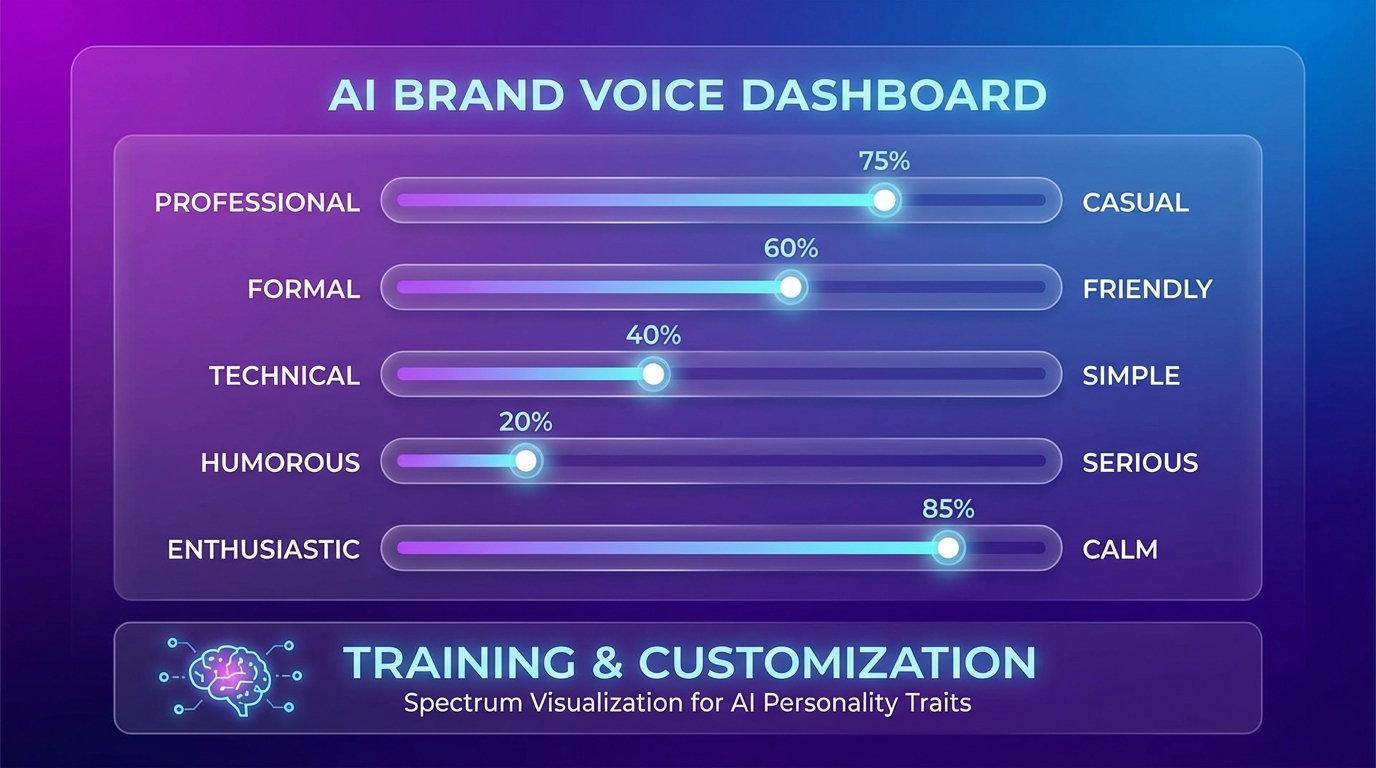
While personality stays consistent, tone flexes based on context. Document tone variations using quantified scales rather than vague descriptors.
The Tone Spectrum Template:
| Dimension | Our Position | Context Notes |
|---|---|---|
| Formal ↔ Casual | 7/10 casual | Professional content: 5/10, Social media: 9/10 |
| Serious ↔ Playful | 6/10 playful | Use humor in blog posts, stay serious for compliance content |
| Respectful ↔ Irreverent | 8/10 respectful | We challenge ideas, not people |
| Enthusiastic ↔ Matter-of-fact | 7/10 enthusiastic | High energy for launches, measured for thought leadership |
| Technical ↔ Simplified | 6/10 technical | Audience-dependent: technical for practitioners, simplified for executives |
Pillar 3: Language Rules (The Guardrails)
These are your non-negotiables. What you always do, what you never do, and specific word choices that define your voice.
Always Use:
- Contractions (we’re, you’ll, it’s) to maintain conversational tone
- Active voice (“We built” not “It was built by us”)
- Second person (“you”) to speak directly to readers
- Short paragraphs (2-3 sentences max) for scannability
- Specific examples over abstract concepts
Never Use:
- Corporate jargon (“synergy,” “leverage,” “circle back”)
- Passive voice except when necessary for clarity
- Exclamation points more than once per 500 words
- Gendered language (use “they” as singular pronoun)
- ALL CAPS for emphasis (use italics or bold)
Vocabulary Preferences:
- “Start” not “commence”
- “Help” not “facilitate”
- “Use” not “utilize”
- “Show” not “demonstrate”
- “About” not “approximately”
Signature Phrases: Every brand has expressions that feel distinctly theirs. Document these. They’re often the difference between “sounds like AI” and “sounds like us.”
| Generic | Our Version | Why |
|---|---|---|
| ”In conclusion…" | "Here’s what matters…” | More direct and action-oriented |
| ”Let’s dive in…" | "Here’s how it works…” | Less cliché, more specific |
| ”Game-changer" | "Makes a real difference” | Less hype, more authentic |
| ”Best practices" | "What actually works” | Emphasizes practical results |
Pillar 4: Content Examples (The Training Data)
This is what separates good brand voice documentation from great. Select 2-5 pieces of high-quality content that best represent your brand’s writing style.
What to Include:
- Your best-performing blog post (one that feels most “you”)
- A social media thread that captured your voice perfectly
- An email that generated high engagement
- A product description that converted well
- Internal communications that exemplify your tone
How to Use Them: Don’t just attach the files. Annotate them. Highlight specific paragraphs with notes like:
- “This opening hook is perfect—notice how it goes straight to the reader’s pain point”
- “This section balances technical details with accessibility”
- “This conclusion gives clear next steps without being salesy”
AI learns from examples more than rules. A single annotated example teaches more than a page of abstract guidelines.
Prompt Engineering for Brand Voice Consistency
Once you’ve documented your voice, you need to translate it into prompts AI can follow. The key to achieving consistent brand voice with AI is in the details of your prompts.
The 80/20 Prompt Formula
80% specific guidance + 20% flexibility = consistent yet natural content.
Bad Prompt (Too Vague):
Write a blog post about email marketing in a friendly tone.Good Prompt (80/20 Balance):
Write a 1,200-word blog post about email marketing best practices.
VOICE REQUIREMENTS:- Tone: 7/10 casual (professional but conversational)- Use contractions and active voice throughout- Include specific examples rather than abstract concepts- Avoid jargon like "leverage," "optimize," "synergy"- Open with a relatable problem statement, not generic introduction
STRUCTURE:- Start with "Why does [problem] happen?" format- Use 2-3 sentence paragraphs max- Include at least 3 actionable tips with real examples- End with clear next steps, not vague "conclusions"
WHAT NOT TO DO:- Don't use exclamation points excessively- Don't write "Let's dive in" or other clichés- Don't make unsubstantiated claims without data
Write naturally within these parameters. You have flexibility in word choice and creative approaches as long as you maintain the specified tone and structure.Prompt Templates by Content Type
Copy these templates and customize with your brand voice guidelines.
Blog Post Prompt:
Write a [word count] blog post about [topic] for [target audience].
BRAND VOICE:- Personality: [your 3-5 traits]- Tone scale: [your quantified dimensions]- Always: [your always-use list]- Never: [your never-use list]
CONTENT GOALS:- Primary: [educate/persuade/entertain]- Keywords to include naturally: [list]- Call to action: [specific action]
VOICE REFERENCE:[Paste 2-3 paragraphs from your best example content]↑ Match this style and energy.
OUTPUT REQUIREMENTS:- [Specific structural requirements]- [Formatting preferences]- [Example quality standards]
Social Media Prompt:
Create a [platform] post about [topic].
BRAND VOICE (SOCIAL VERSION):- Tone: [X/10 on casual scale] - more casual than blog content- Length: [character/word limit]- Emoji use: [never/sparingly/freely]- Hashtag approach: [branded only/mix/trending]
ENGAGEMENT GOAL:- Primary action: [comment/click/share]- Hook style: [question/bold statement/story]
VOICE SAMPLE:[Your best-performing post in this format]↑ Replicate this engagement style.
PLATFORM-SPECIFIC:- [LinkedIn: more professional/thought leadership]- [Twitter: punchier, more personality]- [Instagram: visual-first, story-driven]
Email Prompt:
Write a [email type] to [audience segment] about [topic].
BRAND VOICE (EMAIL VERSION):- Tone: [X/10 scale] - warmer and more direct than blog- Subject line style: [specific approach]- Opening approach: [first name + casual/formal greeting]- Sign-off: [your standard signature]
EMAIL STRUCTURE:- Subject line: [requirements]- Preview text: [approach]- Body: [paragraph count/length]- CTA: [specific action + button/link text]
AVOID:- Marketing speak that triggers spam filters- [Your specific never-use list]
VOICE REFERENCE:[Your highest-performing email intro + CTA]
Advanced: Context-Aware Prompts
The best AI brand voice adapts to context while maintaining core identity. Tone flexes across channels while personality stays constant.
Situation-Based Prompt Additions:
ADAPT TONE FOR CONTEXT:
If addressing a customer complaint:- Shift to 8/10 empathetic, 9/10 solution-focused- Lead with acknowledgment, then solution- Remove all promotional language
If announcing a feature:- Shift to 7/10 enthusiastic (vs usual 5/10)- Lead with customer benefit, not feature details- Include specific use case examples
If writing thought leadership:- Shift to 6/10 formal (vs usual 7/10 casual)- Include more data/research citations- Reduce humor, increase insight depth
Tools Comparison: Where to Train Your AI Brand Voice
You’ve documented your voice and created prompts. Now you need a tool that remembers this training across conversations. ChatGPT, Claude, and Jasper all now allow you to train a custom AI on your brand voice.
Here’s how they compare for brand voice training. For a broader comparison of AI writing platforms, see our guide to the best AI content generators for SaaS founders.
Custom GPTs (ChatGPT)
Best For: Repeatable tasks like social media captions, email templates, or content formatting.
How It Works:
- Create a Custom GPT with your brand voice documentation in the instructions
- Upload example content as knowledge files
- Share the GPT URL with team members
Pros:
- Easy to create (10-15 minutes)
- Shareable via public links
- Works across devices/sessions
- Good for task-specific voice training
Cons:
- Limited context window for complex documents
- Less effective for long-form content
- Can’t maintain voice across multi-session projects
Setup Process:
- Go to ChatGPT → Explore GPTs → Create
- In “Instructions” paste your brand voice framework
- Upload 3-5 example content files
- Test with various prompts and refine
- Share link with team
Best Use Case Example: “Social Media Caption Generator” - Trained on your best 20 social posts, generates on-brand captions for any image or announcement in 10 seconds.
Claude Projects
Best For: Long-form content, complex documents, and maintaining voice across multi-session projects.
How It Works:
- Create a Project with Custom Instructions
- Add your brand voice guide and examples to Project Knowledge (up to 200,000 tokens)
- All conversations in that project automatically use your voice training
Pros:
- Massive context window (200K tokens)
- Significantly outperforms Custom GPTs in complex or document-heavy use cases
- Maintains voice across lengthy content creation
- Better at preserving your specific word choices and expressions
Cons:
- Not shareable outside your organization
- Requires Claude Pro subscription ($20/month)
- Less intuitive interface than Custom GPTs
Setup Process:
- Claude.ai → Projects → Create Project
- Add Custom Instructions (your brand voice framework)
- Upload Project Knowledge (brand guide, example content, style docs)
- Create separate projects for different content types if needed
Best Use Case Example: “Long-Form Blog Writer” - Maintains consistent voice across 3,000+ word articles, references your brand guide and product docs automatically, preserves tone from intro to conclusion.
Jasper Brand Voice
Best For: Marketing teams needing brand voice across multiple content types with built-in templates.
How It Works:
- Upload company description, example content, and voice attributes
- Jasper analyzes and creates a persistent brand voice profile
- All content generation automatically applies your voice
Pros:
- Purpose-built for brand voice training
- Includes content templates pre-configured for different formats
- Team collaboration features
- Chrome extension for anywhere access
Cons:
- Expensive ($49-$125/month)
- Overkill if you only need occasional content
- Learning curve for advanced features
Setup Process:
- Jasper → Brand Voice → Add New Voice
- Upload 3-5 content samples (minimum)
- Fill out voice attributes questionnaire
- Jasper generates your voice profile
- Apply to any content template
Best Use Case Example: “Marketing Content Hub” - Multiple team members generating ads, blog posts, emails, and social content with guaranteed brand consistency.
HubSpot AI Brand Voice
Best For: HubSpot users who want brand voice training integrated with their CMS and marketing automation.
How It Works:
- AI analyzes your existing HubSpot content
- You refine the automatically generated voice profile
- Voice applies to all HubSpot AI features (email assistant, blog ideas, etc.)
Pros:
- Already included with HubSpot subscription
- Learns from your existing content library
- Integrated with campaigns and automation
- No separate tool to manage
Cons:
- Only works within HubSpot ecosystem
- Less customization than standalone tools
- Voice quality depends on existing content quality
Best Use Case Example: “Integrated Marketing Voice” - Maintain consistent voice across HubSpot emails, landing pages, blog posts, and social scheduling without leaving the platform.
Tool Selection Decision Tree
Choose Custom GPTs if:
- You need quick, repeatable tasks (social captions, email templates)
- Budget is limited (included with ChatGPT Plus at $20/month)
- You want to share with external contractors easily
Choose Claude Projects if:
- You create long-form content (1,500+ words regularly)
- You need to reference extensive documentation
- You value superior context retention across sessions
Choose Jasper if:
- You have a dedicated marketing team creating diverse content types
- Budget allows ($125+/month)
- You need collaboration features and template libraries
Choose HubSpot AI if:
- You already use HubSpot extensively
- You want voice training integrated with your marketing stack
- Your content library is substantial enough for AI analysis
The Brand Voice Training Process (Step-by-Step)
Theory is useless without implementation. Here’s the exact process for training AI on your brand voice, with realistic timelines.
Phase 1: Documentation (Week 1)
Time Investment: 3-4 hours
Tasks:
-
Define 3-5 personality traits with specific definitions (1 hour)
- Gather team input on “How would you describe our brand to a friend?”
- Choose traits that are specific and defensible
- Write what each trait means AND doesn’t mean
-
Map tone dimensions on quantified scales (1 hour)
- Rate your position on 5-7 key dimensions (formal↔casual, serious↔playful, etc.)
- Note context variations (blog vs social, customer service vs marketing)
- Review with stakeholders for alignment
-
Document language rules (1 hour)
- List 10+ always-use guidelines
- List 10+ never-use rules
- Identify signature phrases and vocabulary preferences
-
Select and annotate examples (1 hour)
- Choose 5-10 pieces of your best content
- Highlight specific sections that exemplify your voice
- Add annotations explaining why each example works
Deliverable: Brand Voice Guide (3-5 page document)
Phase 2: Initial Training (Week 2)
Time Investment: 2-3 hours
Tasks:
-
Choose your primary tool (30 minutes)
- Based on use cases and budget
- Set up account and familiarize with interface
-
Configure tool with your voice (1 hour)
- Custom GPT: Create GPT, add instructions, upload examples
- Claude Projects: Create project, add Custom Instructions, upload knowledge
- Jasper: Add Brand Voice, upload samples, complete questionnaire
-
Create prompt templates (1 hour)
- Blog post prompt
- Social media prompt
- Email prompt
- Save as reusable templates
Deliverable: Configured AI tool ready for testing
Phase 3: Testing & Refinement (Weeks 3-4)
Time Investment: 4-5 hours spread across two weeks
Tasks:
-
Generate test content (2 hours)
- Create 5-10 pieces across different content types
- Don’t edit yet—just generate raw output
- Include variety: different topics, tones, formats
-
Voice audit against guidelines (2 hours)
- Score each piece on personality traits (1-10 scale)
- Check tone dimensions match targets
- Verify language rules compliance
- Identify patterns in where AI drifts from brand voice
-
Refine training materials (1 hour)
- Add specific examples where AI struggled
- Make rules more explicit where misunderstanding occurred
- Update prompt templates with clearer guidance
- Re-test same prompts to measure improvement
Deliverable: Refined voice training achieving 80%+ brand alignment
Phase 4: Team Rollout (Week 5)
Time Investment: 2-3 hours
Tasks:
-
Create team documentation (1 hour)
- How to access the trained AI tool
- When to use AI vs when to write manually
- Prompt templates for common tasks
- Quality checklist for AI-generated content
-
Conduct training session (1 hour)
- Walk through brand voice guide
- Demonstrate tool usage with live examples
- Practice session where team generates content
- Q&A on voice guidelines
-
Establish review process (30 minutes)
- Who reviews AI content before publishing?
- What’s the approval workflow?
- How do we capture feedback for ongoing improvement?
Deliverable: Team trained and producing brand-aligned AI content
Phase 5: Monitoring & Improvement (Ongoing)
Time Investment: 1-2 hours per month
Tasks:
-
Monthly voice audits (1 hour)
- Review 10-15 pieces of published AI content
- Score against brand voice guidelines
- Track consistency trends over time
- Identify new drift patterns
-
Quarterly refinement (1 hour per quarter)
- Update brand voice guide based on business evolution
- Add new example content as it’s created
- Refine prompt templates based on team feedback
- Update AI tool training with new materials
Deliverable: Continuously improving voice consistency
Before & After: Real Brand Voice Transformations
Seeing the difference makes the concept concrete. Here are three real transformations from generic AI to brand-aligned content.
Example 1: B2B SaaS (Authoritative but Accessible)
Generic AI Output:
Email marketing is a crucial component of modern digital marketing strategies.Organizations that leverage email marketing effectively can see significantimprovements in customer engagement metrics and overall ROI. To optimize youremail marketing initiatives, it's essential to implement best practices andutilize data-driven approaches.After Brand Voice Training:
Your email list is your most valuable marketing asset. Why? Because thesepeople actually want to hear from you—they gave you permission.
But most companies waste this gift by sending generic newsletters nobody reads.Here's what actually works: segment your list by behavior (not demographics),write subject lines that spark curiosity, and give value before asking for anything.
The data backs this up. Companies doing email right see 40% higher open ratesand 3x the conversions of those mass-blasting everyone with the same message.
What Changed:
- Personality: From corporate (“leverage,” “utilize”) to conversational (“Here’s what actually works”)
- Structure: From abstract concepts to concrete advice
- Proof: From vague claims (“significant improvements”) to specific data (“40% higher,” “3x the conversions”)
- Reader focus: From organization-centric to reader-benefit focused
Example 2: Lifestyle Brand (Playful and Inspiring)
Generic AI Output:
Self-care is important for maintaining mental and physical health. Considerimplementing a morning routine that incorporates activities such as meditation,exercise, and healthy breakfast choices. Research indicates that consistentmorning routines can improve productivity and overall wellbeing.After Brand Voice Training:
You know that feeling when you hit snooze three times, scroll Instagram in bedfor 20 minutes, then panic-rush through your morning? That used to be me everysingle day.
Then I discovered something wild: the first hour of your day sets the emotionaltone for the entire day. Not in a toxic-positivity way, but in a "your brainliterally releases different neurochemicals based on your morning choices" way.
I'm not telling you to wake up at 5am and run a marathon. Start tiny: fiveminutes of stretching before checking your phone. That's it. You'll be shockedhow that one shift ripples through your day.
What Changed:
- Tone: From instructional (“consider implementing”) to conversational storytelling
- Relatability: Personal anecdote instead of generic advice
- Language: Casual expressions (“something wild,” “toxic-positivity”) vs formal (“incorporate activities”)
- Approach: Showing before telling, making science accessible
Example 3: Technical Brand (Expert but Not Condescending)
Generic AI Output:
API authentication best practices include utilizing secure token-based systems,implementing proper rate limiting, and ensuring encrypted transmission ofsensitive data. Developers should follow OWASP guidelines and regularly audittheir authentication implementations for potential vulnerabilities.After Brand Voice Training:
Bad API authentication is like leaving your house key under the doormat. Sure,it's convenient—but you're one breach away from disaster.
Here's the non-negotiable security baseline:
1. Token-based auth (OAuth 2.0 or JWT)—never pass API keys in URLs wherethey'll end up in server logs forever2. Rate limiting—if someone's hitting your API 1000 times per second, that'snot a legitimate user3. HTTPS everywhere—encrypting tokens in transit isn't optional
The OWASP API Security Top 10 breaks down specific vulnerabilities, but thesethree catch 80% of common authentication fails. Get these right beforeoptimizing anything else.
What Changed:
- Opening: Relatable analogy before technical details
- Structure: Numbered list with explanatory context (not just bullet points)
- Language: Plain English explanations in parentheses after technical terms
- Priority: “Non-negotiable baseline” and “80% of common fails” frames decisions
- Respect: Assumes reader intelligence while still explaining reasoning
Common Pitfalls (And How to Avoid Them)
Even with proper training, brands make predictable mistakes. Here’s what to watch for.
Pitfall 1: Vague Personality Traits
The Mistake: Choosing generic traits like “professional,” “friendly,” or “innovative” without specific definitions.
Why It Fails: AI interprets “friendly” a thousand different ways. Is that warm and nurturing? Casual and humorous? Helpful and patient?
The Fix: Add specific behavioral definitions.
- Bad: “We’re friendly”
- Good: “We’re friendly: conversational tone like talking to a knowledgeable coworker, using contractions and occasional humor, but never forced jokes or excessive exclamation points”
Pitfall 2: One-Size-Fits-All Voice
The Mistake: Applying identical voice guidelines to every content type and platform.
Why It Fails: Your blog voice, social media voice, and customer support voice should share core personality but flex tone for context.
The Fix: Document context-specific variations.
- Core personality: Authoritative, clear, action-oriented (consistent everywhere)
- Blog tone: 6/10 casual, more educational
- Social tone: 8/10 casual, more personality-driven
- Support tone: 9/10 empathetic, solutions-focused
Pitfall 3: Insufficient Training Examples
The Mistake: Providing just your brand guidelines document without actual content examples.
Why It Fails: AI learns from examples more than rules. Guidelines tell AI what you want; examples show it.
The Fix: Include 5-10 diverse content samples:
- Your best blog post
- Your highest-engaging social thread
- Your most-clicked email
- Product copy that converted well
- Internal communication that captured your voice
Pitfall 4: No Review Process
The Mistake: Publishing AI-generated content without human review because “we trained it properly.”
Why It Fails: AI occasionally hallucinates facts, misses nuance, or drifts from brand voice in subtle ways.
The Fix: Implement tiered review:
- Tier 1 (Quick Tasks): Social captions, email subject lines—light edit okay
- Tier 2 (Standard Content): Blog posts, newsletters—thorough review required
- Tier 3 (Brand-Critical): Thought leadership, press releases—treat AI as first draft, heavy human involvement
Pitfall 5: Static Training (Set and Forget)
The Mistake: Training AI once and never updating the voice guidelines or examples.
Why It Fails: Your brand evolves. Your audience evolves. Your voice should too. Regular updates and retraining keep AI aligned.
The Fix: Schedule ongoing maintenance:
- Monthly: Quick voice audit of 10-15 AI-generated pieces
- Quarterly: Add 2-3 new example pieces to training
- Annually: Full brand voice guide refresh based on business evolution
Pitfall 6: Ignoring AI’s Verbal Tics
The Mistake: Not recognizing and correcting AI’s habitual phrases that don’t match your brand.
Why It Fails: Every AI model has phrases it gravitates toward: “delve into,” “it’s important to note,” “landscape,” “robust.” These reveal AI-generated content.
The Fix: Add explicit “never use” rules:
FORBIDDEN PHRASES (AI tells, but not brand voice):- "Delve into" → Use "explore" or "examine"- "It's important to note" → Just state the point directly- "In today's digital landscape" → Be more specific about context- "Robust" → Use "powerful," "comprehensive," or "reliable"- "Cutting-edge" → Show don't tell: explain what makes it advancedMeasuring Success: Voice Consistency Metrics
You can’t improve what you don’t measure. Here’s how to track AI brand voice performance.
Metric 1: Voice Alignment Score
What It Measures: How closely AI output matches your brand voice guidelines.
How to Calculate:
- Create a scoring rubric based on your personality traits (1-10 scale each)
- Review 10 pieces of AI content monthly
- Score each piece on each trait
- Calculate average across all traits and all pieces
Example Rubric:
- Authoritative (but not arrogant): Does it speak from expertise without condescension? [1-10]
- Clear (but not simplistic): Is it easy to understand without being dumbed down? [1-10]
- Action-oriented (but not pushy): Does it provide clear next steps without aggressive sales tactics? [1-10]
Target: 8+ average score indicates strong voice alignment.
Metric 2: Time Savings
What It Measures: Efficiency gains from AI assistance.
How to Calculate:
- Track time to produce content before AI training (benchmark)
- Track time to produce equivalent content with trained AI
- Calculate hours saved per week/month
Expected Results: Teams report saving approximately three hours per day (70 hours per month) once AI is properly trained.
Metric 3: Content Consistency Across Creators
What It Measures: Whether different team members using trained AI produce similar voice quality.
How to Calculate:
- Have 3+ team members create content on the same topic using trained AI
- Blind review all pieces
- Score consistency using voice alignment rubric
- Measure variation (lower variation = better consistency)
Target: Less than 2-point variance in voice scores across different creators.
Metric 4: Audience Response
What It Measures: Whether your audience responds equally well to AI-assisted content vs. human-only content.
How to Calculate:
- Track engagement metrics (time on page, social shares, email opens/clicks)
- Tag content as “AI-assisted” or “human-only” in your analytics
- Compare performance over 3-month period
- Run occasional A/B tests of same topic (AI vs human)
Target: AI-assisted content performs within 10% of human-only content.
Your Brand Voice Training Checklist
Use this checklist to ensure you’ve covered everything needed for successful AI brand voice training.
Documentation Phase:
- Defined 3-5 specific personality traits with behavioral examples
- Mapped tone dimensions on quantified scales (X/10 format)
- Created “always use” language rules (10+ items)
- Created “never use” language rules (10+ items)
- Documented signature phrases and vocabulary preferences
- Selected 5-10 high-quality content examples
- Annotated examples with specific voice observations
- Compiled everything into a Brand Voice Guide document
Tool Setup Phase:
- Chose primary AI tool based on use cases and budget
- Created Custom GPT / Claude Project / Jasper Brand Voice
- Uploaded brand voice guide to tool
- Added example content to tool’s training
- Created prompt templates for 3+ content types
- Tested tool with 5+ diverse prompts
- Documented access instructions for team
Testing Phase:
- Generated 10+ test pieces across content types
- Scored test content against voice alignment rubric
- Identified specific areas where AI drifts from brand voice
- Refined training materials based on test results
- Re-tested to confirm improvement
- Achieved 80%+ voice alignment score
Team Rollout Phase:
- Created team documentation on tool usage
- Defined when to use AI vs. write manually
- Established content review/approval workflow
- Conducted team training session on brand voice + AI tool
- Set up monthly voice audit process
- Designated voice quality owner/champion
Ongoing Optimization:
- Scheduled monthly voice audits (1 hour)
- Scheduled quarterly training updates (1 hour)
- Created feedback collection process
- Set up metrics tracking (voice score, time savings, consistency)
- Planned annual brand voice guide refresh
Scale Content Without Losing Your Voice
Suparank trains AI on your brand voice automatically, then generates SEO-optimized content that sounds exactly like you. No prompt engineering required.
Conclusion: AI That Sounds Like You
Training AI to match your brand voice isn’t a one-time setup. It’s an ongoing practice of documenting, training, testing, and refining. But the investment pays exponential dividends.
The brands winning with AI content share three characteristics:
-
They documented their voice before training AI. You can’t teach what you haven’t defined. The brand voice framework ensures consistency even as team members change.
-
They treat AI as a trained assistant, not a replacement. The best AI-assisted content comes from teams who use AI to draft, scale, and maintain consistency while humans add strategic insight, nuance, and quality control. For implementation details, see our guide on setting up an AI blog writing workflow.
-
They iterate continuously. Your first attempt at AI brand voice training won’t be perfect. But with monthly audits and quarterly refinements, you’ll develop AI that produces 80-90% ready-to-publish content that sounds authentically you.
The alternative? Continue bottlenecking content through a few key writers, unable to scale, sacrificing consistency as you rush to publish. Or worse—using generic AI that makes all your content sound like everyone else’s.
Your brand voice is a competitive advantage. Train AI to protect and scale it.
Sources
- Using AI for a Strong Brand Voice: Dos and Don’ts
- How to Perfect Your AI Brand Voice for Customer Service
- How to Train Generative AI to Speak in Your Brand Voice
- AI and Brand Voice: Your Secret to Quality Scalable Content
- How to Build Your AI Brand Voice (That Actually Sounds Like You)
- Step-by-Step Brand Voice Guidelines + Framework
- Brand Voice: Definition, Benefits, and Best Practices
- Brand Voice & Tone Building With Prompt Engineering
- Mastering Prompt Engineering for a Consistent Brand Voice
- Using Tone and Style Prompts for Brand Consistency in AI Content
- Claude’s Projects Is a User-Friendly Version of Custom GPTs
- How to Build a Custom GPT, Claude Project, or Gemini Gem in 2025
- Claude Projects vs. Custom GPTs: Which AI Tool is Best for Your Business?
- The Complete Guide to Custom GPT Instructions for Content Creation
- AI Brand Voice Generator: How to Maintain Consistent Channel-Specific Voices
- HubSpot: Set Up Brand Voice Using AI
- Jasper AI-Powered Brand Voice Management
Frequently Asked Questions
How long does it take to train AI on my brand voice?
Can AI really capture my unique brand personality?
What's the best tool for brand voice training - Custom GPTs or Claude Projects?
How do I measure if AI is matching my brand voice?
Tags
More articles

AI Writer vs Human Writer: When to Use Each in 2026
AI writing is 4.7x cheaper and 10x faster than human writers, but human content gets 5.44x more traffic. Discover when to use each for maximum ROI based on 2026 performance data.


7 Best AI Content Generators for SaaS Founders in 2026
Discover the top AI content generators that help SaaS founders create SEO-optimized blog posts, marketing copy, and long-form content faster. Compare features, pricing, and real-world performance.
Best AI Writing Tools in 2026: The Definitive Guide
Discover the top AI writing tools in 2026. Compare features, pricing, and capabilities of 12+ tools including ChatGPT, Claude, Jasper, and more to find the perfect fit for your content needs.