Content Marketing for Indie Hackers: The AI-Powered Playbook
Learn how successful indie hackers use AI tools and lean content strategies to build profitable SaaS products without a marketing budget. Real examples, free tools, and actionable tactics.
Jump to section
You’re a solo founder building in public. You’ve shipped your MVP. Now you need customers.
But you don’t have a marketing budget. No team. No time for complex campaigns.
Here’s the reality: the indie hackers earning $20k-$40k MRR aren’t outspending you. They’re out-creating you.
And in 2026, they’re doing it with AI. Technical founders building in public should also explore our vibecoder’s guide to content marketing for developer-specific strategies.
The Indie Hacker’s Content Dilemma
You’ve heard the advice: “Just create content.”
But between coding features, handling support, and keeping the lights on, where do you find 20 hours a week for content creation?
You don’t. Because successful indie hackers aren’t spending 20 hours on content.
They’re spending 3-5 hours and leveraging AI for the rest.
The New Reality: AI as Your Content Co-Founder
The share of solo-founded, bootstrapped startups climbed from 22.2% in 2015 to 38% in 2024. Here’s why: AI-native startups achieve product-market fit with fewer employees.
Solo founders can now:
- Bootstrap longer without VC pressure
- Retain more equity
- Compete with funded competitors
- Adapt faster to market shifts
The advantage isn’t money. It’s velocity.
Why Content Marketing Works for Bootstrapped Products
Let’s look at the numbers.
Platform Performance Comparison
| Platform | Conversion Rate | Best For | Cost |
|---|---|---|---|
| Indie Hackers | 23.1% per engaged post | Sustained engagement | Free |
| Product Hunt | 3.1% per launch | One-day spike | Free |
| SEO/Blog | 3-8% (long-term) | Compounding traffic | Time only |
| Twitter/X | 2-5% (varies widely) | Real-time engagement | Free |
| 1-4% (if done right) | Niche communities | Free |
Key insight: Indie Hackers delivers 7.4x better conversion than Product Hunt. But only if you can sustain engagement for 90+ days.
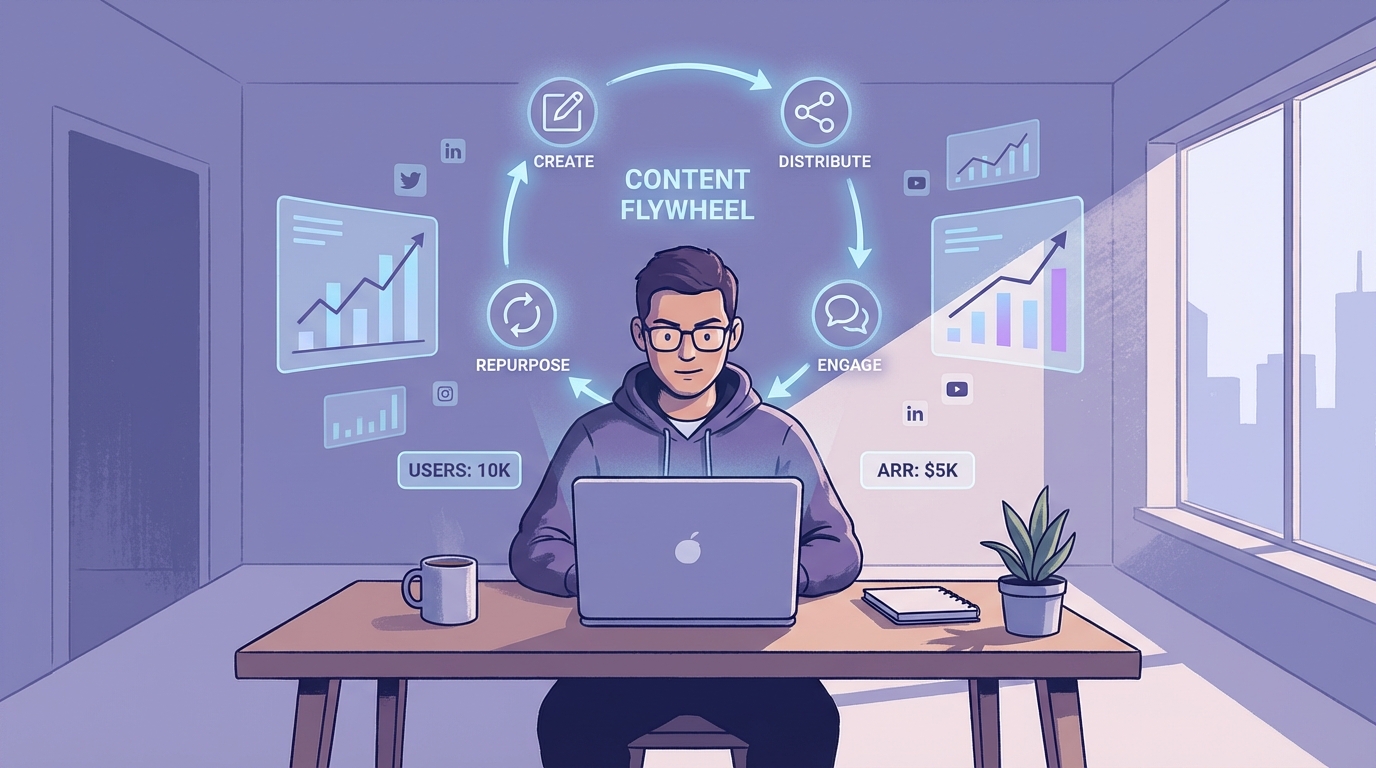
The Content Marketing Flywheel for Indie Hackers
Here’s how successful indie hackers build their content engine:
- Build in Public (daily): Share wins, failures, metrics on Twitter/X
- SEO Content (bi-weekly): Long-form blog posts targeting low-competition keywords
- Community Engagement (daily): Reddit, Indie Hackers, niche Slack groups
- Free Tools (quarterly): Launch micro-tools that attract your ICP
- Cross-Platform Publishing (same content, multiple platforms)
This compounds. Your blog post from 6 months ago still drives signups. Your building-in-public tweets create authentic relationships. Your free tools become SEO assets. If you’re on a tight budget, our SaaS content strategy on a budget guide covers the financial side in detail.
The AI-Powered Content Stack for Bootstrapped Founders
Here’s the exact tool stack successful indie hackers use in 2026:
Writing & Strategy Tools
ChatGPT Projects (Free - $20/mo)
- Create dedicated workspaces for each content type
- Maintain consistent brand voice across all content
- Generate outlines, first drafts, and social snippets
Real example: Set up a “Blog Content” project with your brand guidelines, target keywords, and audience pain points. ChatGPT maintains context across all your content sessions.
Jasper AI (Starts at $49/mo)
- 71 content templates optimized for marketers
- Direct integrations with SEO platforms
- Workflows for consistent output
When to upgrade: When you’re publishing 2+ posts per week and need template-driven consistency.
Visual Content Creation
Canva (Free tier + AI features)
- AI-powered design suggestions
- Templates for every social platform
- Brand kit for consistency
Pro tip: Create 5 branded templates (blog headers, Twitter cards, LinkedIn posts, Instagram stories, YouTube thumbnails). Reuse them for every piece of content.
Adobe Firefly (Free tier available)
- Custom visuals matching your exact specifications
- Solves the “finding the right image” bottleneck
- Generate unique branded illustrations
Video Production
CapCut (Free)
- Complete video production suite
- AI-powered editing and effects
- Export in platform-optimized formats
Lumen5 (Free - $79/mo)
- Turns blog posts into videos automatically
- Suggests stock visuals and adds captions
- Polished drafts in minutes
Use case: Take your blog post, paste it into Lumen5, get a 90-second video for Twitter/LinkedIn in under 10 minutes.
Productivity & Organization
Notion (Free for individuals)
- Content calendar organization
- Research storage
- AI writing assistance built-in
- Collaboration when you scale
The indie hacker’s Notion setup:
- Content Calendar (with status tracking)
- Keyword Research database
- Distribution checklist
- Performance metrics dashboard
The Budget-Conscious Content Strategy
You can’t do everything. Here’s what to prioritize when you have zero budget and limited time.
Phase 1: Foundation (Weeks 1-4)
Goal: Establish presence and start SEO foundation
Time investment: 5 hours/week
Actions:
- Set up blog on your main domain (not Medium/Substack)
- Research 10 low-competition keywords using Google Keyword Planner
- Write and publish 2 comprehensive blog posts (1500+ words each)
- Share building updates on Twitter/X (10 minutes daily)
- Engage in 2 relevant subreddits (read-only at first)
Why this works: SEO content needs time to rank. Plant these seeds early. For strategies on establishing expertise quickly, see our guide on building topical authority fast.
Phase 2: Distribution (Weeks 5-8)
Goal: Amplify existing content across multiple channels
Time investment: 6 hours/week
Actions:
- Repurpose blog posts to Medium and HashNode (canonical URL to your blog)
- Create 5-7 Twitter threads from each blog post
- Turn key points into LinkedIn carousel posts
- Start commenting (thoughtfully) on Indie Hackers posts
- Build an email list with lead magnet (use your blog content)
Key metric: Traffic to your blog should be growing 10-20% weekly.
Phase 3: Community Authority (Weeks 9-16)
Goal: Become known in your niche communities
Time investment: 8 hours/week
Actions:
- Publish one “building in public” update weekly with specific MRR numbers
- Create one free tool related to your product
- Write guest posts for relevant newsletters
- Start a weekly email newsletter
- Host a Twitter Space or appear on indie hacker podcasts
Why this compounds: People buy from people they know. Consistent valuable contributions build trust.
Phase 4: Scale & Automate (Week 17+)
Goal: Systematize your content engine
Time investment: 5 hours/week (through automation)
Actions:
- Batch create content (4 blog posts in one sitting)
- Use AI to generate social snippets from each post
- Schedule distribution across all platforms
- Set up automated email sequences
- Track what’s working, double down
The goal: Spend more time building product, less time on content.
Automate Your Content Workflow
Suparank helps indie hackers generate SEO-optimized blog content in minutes, not hours. Focus on building, let AI handle content.
Distribution Playbook: Where to Share Your Content
Creating content is 20% of the work. Distribution is the other 80%.
Twitter/X: The Indie Hacker’s Home Base
Why it works: Direct engagement, viral potential, and indie hacker community is active here.
What successful indie hackers do:
- Share daily building updates (even small wins)
- Thread format for longer insights
- Reply to bigger accounts in your niche
- Use hashtags: #buildinpublic #indiehacker #SaaS
Real example: One indie hacker’s tweet reposted by Pieter Levels got 200k views and drove significant sales.
Posting cadence: 2-5 times daily (mix of original content and engagement)
Indie Hackers: Long-Term Relationship Building
Why it works: 23.1% conversion rate per engaged post, highly targeted audience
Content that performs:
- Journey posts with specific revenue numbers ($413, $10K, $42K MRR)
- “Ask me anything” posts after hitting milestones
- Detailed breakdowns of what’s working/not working
- Tool recommendations and teardowns
Strategy: 90% value, 10% product mention. Build relationships over months, not days.
Reddit: The Gold Mine (If You Do It Right)
Why it’s challenging: Redditors have strong BS detectors. Self-promotion without value = downvotes.
How to win on Reddit:
- Join niche subreddits (not r/entrepreneur)
- Contribute genuinely for 4-6 weeks before any promotion
- When you share, make it 95% value, 5% “I built this”
- Engage with haters positively (they give you visibility)
Best subreddits for indie hackers:
- r/SaaS
- r/Entrepreneur
- r/startups
- Industry-specific subreddits (e.g., r/fitness for fitness apps)
Real example: The founders of examine.com were moderators of r/Fitness, created content for that community, and built a highly successful startup.
Product Hunt: Launch Day Spike
The reality: Product Hunt gives you one day of intense visibility but lower conversion (3.1%).
Use it for:
- Initial launch buzz
- Collecting early feedback
- Getting backlinks
- Building email list
Don’t rely on it for: Sustainable growth
Pro tip: Prepare your community in advance. Share your upcoming launch on Twitter, Indie Hackers, and relevant Slack groups. Coordinate support on launch day.
Hacker News: High Risk, High Reward
When it works: Thoughtful, technical posts that provide unique insights
When it fails: Anything that feels like marketing
Best approach: Share genuinely useful technical content, tools, or deep dives. If you hit the front page, expect 10k-50k visitors in 24 hours.
Multi-Channel Content Distribution Checklist
For every piece of content you create:
- Publish on your blog (primary)
- Share on Twitter/X (with key insights, not just a link)
- Post to LinkedIn (with native content, not just link)
- Cross-post to Medium and HashNode (canonical URL to your blog)
- Share in relevant Indie Hackers groups
- Post in 1-2 relevant subreddits (following community rules)
- Send to email list (if you have one)
- Turn into video content (Lumen5 or CapCut)
- Create carousel post for LinkedIn/Instagram
- Save best insights for future Twitter threads
Real Indie Hacker Success Stories
Let’s look at founders who’ve built profitable businesses using content marketing.
Pieter Levels (@levelsio): $200k/month
Products: PhotoAI, InteriorAI, NomadList, RemoteOK
Content strategy:
- Constant building in public on Twitter
- Shipping 12+ products rapidly, documenting everything
- Controversial takes that drive engagement
- Zero traditional marketing spend
Key lesson: Ship fast, document everything, be authentic even when controversial.
Danny Postma: Profile Picture AI & HeadShotPro
Content strategy:
- Leveraged success story from previous exit (Headlime)
- Built audience by sharing revenue numbers
- Created content around AI-generated images (his product category)
- Established authority in niche before launching
Key lesson: Content creates authority, authority drives sales.
Marc Louvion: $40k/month
Content strategy:
- Building in public with transparent metrics
- Weekly updates on what’s working/failing
- Community-first approach on Twitter and Indie Hackers
- Started creating content before building product
Key lesson: Audience first, product second.
Alex West: CyberLeads ($40k MRR)
Journey: 19 failed products before finding success
Content strategy:
- Documented every failure publicly
- Shared lessons learned from each failed attempt
- Built credibility through persistence and transparency
- When CyberLeads worked, had an audience ready to support
Key lesson: Failure stories build more trust than success stories.
Anonymous Developer: $22k MRR Portfolio
Strategy: Changed from single-product focus to 30-app portfolio
Content approach:
- Each app gets basic SEO content
- Cross-promote between apps
- Diversified traffic sources
- Built in public about portfolio strategy
Key lesson: Multiple small bets can outperform one big bet.
The Time-Saving Automation Playbook
The secret to sustainable content marketing as a solo founder: ruthless automation.
Content Creation Automation
Batch creation workflow:
- Block 4 hours once a month
- Research 8-10 topics in one session
- Create outlines using ChatGPT
- Write first drafts in one sitting
- Edit and schedule throughout the month
AI-powered expansion:
- One blog post → 7 Twitter threads
- One Twitter thread → LinkedIn carousel
- One blog post → 3 email newsletters
- One case study → 10 social posts
Tools that help:
- ChatGPT for repurposing content
- Buffer/Hypefury for social scheduling
- ConvertKit for email automation
- Canva for quick visual creation
Distribution Automation
Set it and forget it:
- Schedule social posts 2 weeks in advance
- Automate cross-posting (blog → Medium/HashNode)
- Set up RSS-to-email for new blog posts
- Use Zapier to post blog updates to Slack communities
What NOT to automate:
- Direct engagement and replies
- Community contributions on Reddit/Indie Hackers
- Relationship building DMs
- Responding to comments
The Weekly Time Budget
Here’s how to fit content marketing into 5 hours per week:
Monday (1 hour): Plan and schedule week’s content Tuesday (30 min): Engage on Twitter, respond to comments Wednesday (2 hours): Write/record new content piece Thursday (30 min): Community engagement (Reddit, Indie Hackers) Friday (1 hour): Analytics review, prepare next week
That’s it. 5 hours of focused work beats 20 hours of unfocused effort.
Common Indie Hacker Content Mistakes
Learn from others’ mistakes:
Mistake 1: Waiting to Have an Audience
The trap: “I’ll start sharing once I have something impressive to show”
Why it fails: You need the audience BEFORE launch, not after.
Fix: Start documenting from day zero. Your journey is the content.
Mistake 2: Only Sharing Wins
The trap: Curating a perfect image of success
Why it fails: People connect with struggle, not highlight reels.
Fix: Share the messy middle. Revenue drops, feature failures, customer complaints. Real struggles = real engagement.
Mistake 3: Inconsistent Publishing
The trap: Publishing when inspired, going silent for weeks
Why it fails: Algorithms and audiences reward consistency.
Fix: Commit to minimum viable consistency. Even “just” 2 tweets per week is better than feast-or-famine posting.
Mistake 4: Product-First Content
The trap: Every post is about your product’s features
Why it fails: Nobody cares about your features. They care about their problems.
Fix: 90/10 rule. Give value first, mention your product as the tool that enables that value.
Mistake 5: Spreading Too Thin
The trap: Trying to be everywhere (Twitter, LinkedIn, TikTok, YouTube, etc.)
Why it fails: You produce mediocre content on every platform instead of great content on one.
Fix: Pick TWO channels. Master them. Expand only when those are systematized.
Content Marketing ROI: What to Expect
Let’s set realistic expectations.
Timeline to Results
Months 1-3: Low visibility, building foundation
- Expect: 100-500 blog visitors/month
- Focus: Consistency and learning
Months 4-6: Early traction
- Expect: 500-2,000 blog visitors/month
- Focus: Double down on what’s working
Months 7-12: Compounding begins
- Expect: 2,000-10,000+ visitors/month
- Focus: Scale winning content types
Real example: Indie Hackers grew from zero to 170k sessions in 3 months using content (interviews). But they had unique advantages (founder’s network, built-in shareable content).
More realistic: Expect 6-12 months before content marketing becomes your primary acquisition channel.
Metrics That Matter
Vanity metrics (ignore these):
- Page views
- Social followers
- Likes and shares
Meaningful metrics (track these):
- Email signups from content
- Trial signups from blog traffic
- Time on page (shows content quality)
- Returning visitors (shows value)
- Conversion rate from organic traffic
The only metric that truly matters: Revenue from content-driven customers.
Your 90-Day Content Marketing Action Plan
Ready to start? Here’s your roadmap.
Month 1: Foundation
Week 1: Research and planning
- Identify 20 low-competition keywords
- Set up blog on main domain
- Create social profiles (Twitter, Indie Hackers)
- Install analytics (Google Analytics, Simple Analytics)
Week 2-4: Create initial content
- Write and publish 4 blog posts
- Share daily building updates on Twitter
- Engage on Indie Hackers (read, comment, provide value)
- Start email list with simple lead magnet
Goal: Establish baseline presence
Month 2: Distribution
Week 5-6: Expand reach
- Cross-post blog content to Medium, HashNode
- Create Twitter threads from blog posts
- Post first milestones/metrics on Indie Hackers
- Engage actively in 2 relevant subreddits
Week 7-8: Community building
- Publish 4 more blog posts
- Launch one free tool or resource
- Start weekly email newsletter
- Respond to every comment and mention
Goal: Be known in your niche community
Month 3: Optimization
Week 9-10: Analyze what’s working
- Review analytics, identify top content
- Double down on winning topics
- Create content upgrade for top posts
- Interview a customer (turn into content)
Week 11-12: Scale up
- Batch create 8 blog posts
- Increase Twitter activity
- Guest post opportunity or podcast appearance
- Set up content automation
Goal: Systematize your content engine
Beyond 90 Days
Continue:
- Publishing bi-weekly long-form content
- Daily social engagement (10-15 minutes)
- Weekly email to your list
- Monthly free resource or tool
Add:
- Video content (repurpose blog posts)
- Podcast appearances
- Community partnerships
- Paid collaborations (when budget allows)
Skip the Manual Content Grind
Let AI handle research, writing, and optimization. Suparank generates publication-ready blog content optimized for SEO and conversion. Save 10+ hours per week.
The Indie Hacker’s Content Mindset
Success in content marketing requires a specific mindset shift:
From: “I need to sell my product” To: “I need to help my audience solve problems”
From: “I’ll create content when I have time” To: “Content is how I build my business”
From: “My product isn’t ready to share” To: “The journey is the content”
From: “I need perfect content” To: “Shipped beats perfect”
From: “I’ll create content after launch” To: “I’m building my audience now”
Remember: you’re not just building a product. You’re building a content-driven distribution channel.
The product gets you customers. The content compounds your reach over time.
The best time to start was 6 months ago. The second-best time is now.
Additional Resources
Sources:
- Indie Hackers Launch Strategy 2025
- 2025 Content Trends Micro SaaS Founders Can’t Ignore
- 9 Marketing Strategies I’ve Learned as an Indie Maker
- Top AI Tools Every Solo AI Startup Founder Should Know
- 8 Essential AI Tools for Early-Stage Startup Founders
- Using Low-Cost Marketing Strategies to Generate $26k/mo
- Top Marketing Channels for Indie Hackers
- Indie Hackers Stories Database
- How INDIE HACKERS Grew from Zero to 170k Sessions in 3 Months
Frequently Asked Questions
What's the best content marketing channel for indie hackers with no budget?
Which AI tools should bootstrapped founders use for content creation?
How long does content marketing take to work for a bootstrapped SaaS?
Should indie hackers focus on Product Hunt or content marketing?
Tags
More articles

AI Writer vs Human Writer: When to Use Each in 2026
AI writing is 4.7x cheaper and 10x faster than human writers, but human content gets 5.44x more traffic. Discover when to use each for maximum ROI based on 2026 performance data.


7 Best AI Content Generators for SaaS Founders in 2026
Discover the top AI content generators that help SaaS founders create SEO-optimized blog posts, marketing copy, and long-form content faster. Compare features, pricing, and real-world performance.

Best AI Writing Tools in 2026: The Definitive Guide
Discover the top AI writing tools in 2026. Compare features, pricing, and capabilities of 12+ tools including ChatGPT, Claude, Jasper, and more to find the perfect fit for your content needs.