The Vibecoder's Guide to Content Marketing: Ship Content Like You Ship Code
Learn how to apply the vibecoder mindset to content marketing. Build fast, ship often, and grow your developer audience with strategies that actually work for technical founders.
Jump to section
You’re a vibecoder. You ship MVPs in weekends. You orchestrate AI tools like Cursor and Claude to build products in days that used to take months. You move fast, iterate constantly, and let your code speak for itself.
But here’s the problem: your content marketing strategy is still stuck in 2018.
While you’re vibe coding your way to product-market fit, your content calendar looks like a waterfall project. You’re treating blog posts like they need three rounds of review, perfect SEO optimization, and a content strategist’s blessing before hitting publish. Meanwhile, your competitors who ship content like they ship code are building audiences 10x faster than you.
It’s time to apply the vibecoder mindset to content marketing. If you’re an indie hacker, our content marketing AI playbook for indie hackers covers the fundamentals from a bootstrapper’s perspective.
What Is the Vibecoder Mindset?
In 2026, the development landscape shifted dramatically. According to Medium’s analysis, an Orchestrator can build, test, and deploy a functional SaaS over a long weekend for the cost of an API subscription. Projects that once took weeks can now be built in days—or even hours, with routine development tasks 51% faster and specific use cases like API integration seeing time savings reaching 81%.
The vibecoder mindset has three core principles:
- Velocity over perfection - Ship the MVP, then iterate based on real feedback
- AI orchestration - Use tools like Claude, Cursor, and v0 to amplify your output
- Continuous deployment - Small, frequent releases beat big bang launches
Here’s the revelation: these exact principles work for content marketing.
Why Content Feels Harder Than Code for Developers
Most technical founders struggle with content because they apply the wrong mental model. You wouldn’t spend three weeks perfecting a feature before getting user feedback, yet that’s exactly how traditional content marketing works: brainstorm, outline, write, edit, review, optimize, schedule, publish. By the time you hit publish, the insight is stale and you’ve lost momentum.
Vibecoders understand that speed is the only moat left. In development, your competitive advantage comes from iteration velocity. The same is true for content.
The Vibecoder Content Framework
Let’s rebuild your content strategy from first principles, using the same thinking you’d apply to architecting a codebase.
1. Version Control Your Content
Every vibecoder lives in Git. Your content should too.
What this looks like in practice:
- Store all content in markdown files in a Git repository
- Use branches for drafts, main for published content
- Write commit messages that explain the “why” behind content changes
- Tag releases for major content updates
- Use pull requests for content review (when you need it)
Benefits of version-controlled content:
- Complete history of every change
- Easy rollbacks if something breaks
- Collaboration through PRs instead of Google Docs comments
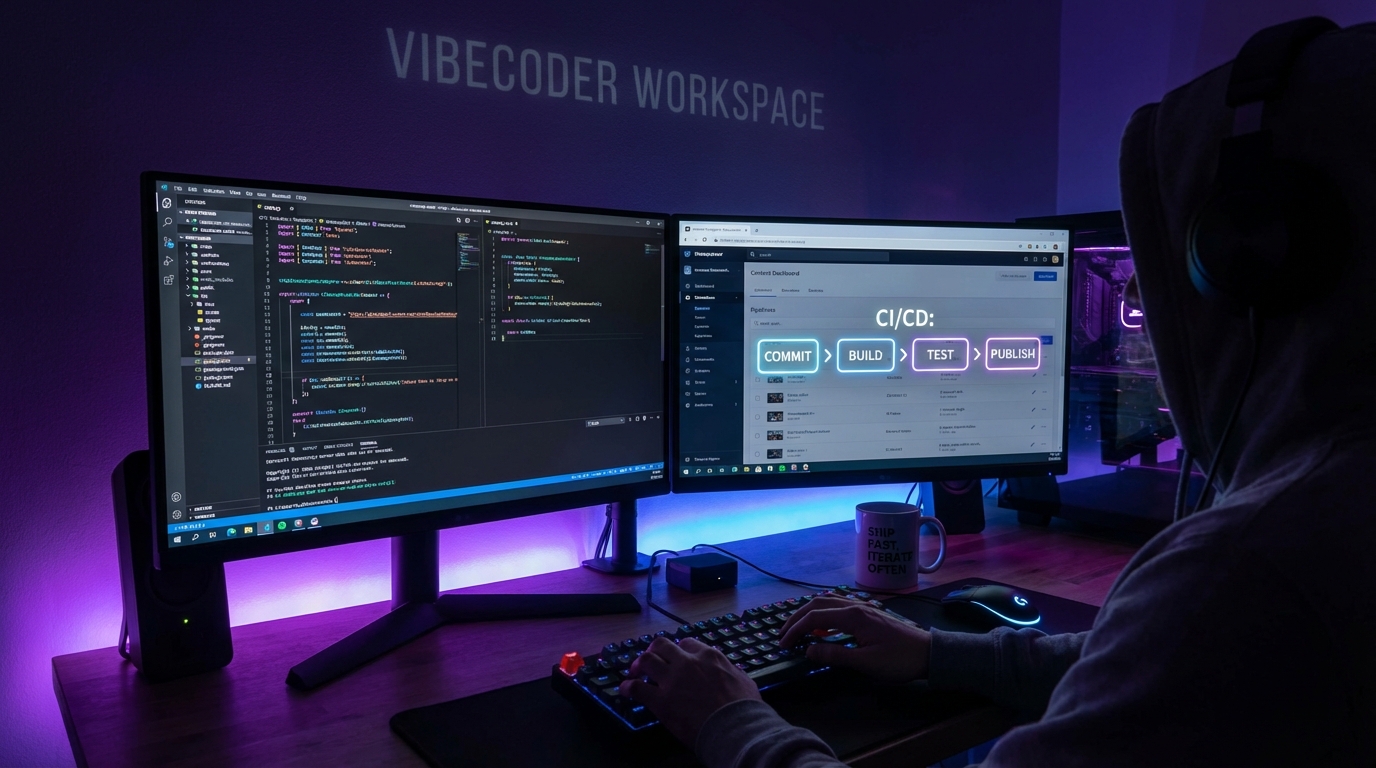
- Automated deployment through CI/CD pipelines
- Public contribution for open-source projects
2. Build a Content Pipeline, Not a Content Calendar
Traditional content calendars are project plans—fixed schedules, dependencies, bottlenecks. Vibecoder content operates on a pipeline model: continuous flow, automated stages, parallel processing.
Here’s what a developer-friendly content pipeline looks like:
| Stage | Traditional Approach | Vibecoder Pipeline |
|---|---|---|
| Ideation | Quarterly brainstorm meetings | Continuous capture (notes app, GitHub issues) |
| Research | Manual research + competitor analysis | AI-powered research aggregation |
| Writing | Write from scratch | AI first draft + human refinement |
| Editing | Multiple rounds of human review | AI grammar check + light technical review |
| SEO | Manual keyword research + optimization | Automated SEO tools + AI suggestions |
| Publishing | Manual CMS upload | Git push → automated deployment |
| Distribution | Manual social posts | Automated cross-posting + webhooks |
According to Strategic Nerds’ developer marketing guide, at early stage (seed through Series A), developer marketing is often done by founders or a single marketing generalist. You don’t have time for the traditional approach. You need automation.
3. Automate Like Your Deployment Pipeline
You wouldn’t manually deploy code to production. Why manually publish content?
Developer-friendly content automation stack:
For Writing & Generation:
- Claude/ChatGPT API: Generate first drafts, expand outlines, create variations
- Suparank MCP: Full content creation pipeline from research to publishing
- ContentBot: Automated blog post flows and scheduled content generation
For Distribution & Deployment:
- GitHub Actions: Trigger builds and deployments on Git push
- Zapier: Connect 5,000+ apps without writing custom integrations
- Twilio: API-based messaging for newsletters and notifications
- Customer.io: Event-driven email automation (triggers based on user actions, not just time)
For Monitoring & Analytics:
- Plausible/Fathom: Privacy-first analytics with simple APIs
- PostHog: Product analytics for content (track how users interact with your posts)
- Custom scripts: Parse UTM parameters, send data to your warehouse, join with product usage
4. Ship Content Like You Ship Features
The vibecoder approach to features applies perfectly to content:
MVP Content: Ship the core insight in 500 words. You can always expand later.
A/B Testing: Try different headlines, formats, and distribution channels. Measure what works.
Feature Flags: Test new content types with small audiences before full rollout.
Continuous Deployment: Publish small updates frequently instead of massive quarterly content drops.
Rollback Strategy: If a piece isn’t performing, unpublish or redirect. Content isn’t permanent.
Hotfix Patches: Found a typo or outdated info? Fix it immediately and push to production.
Building in Public: The Ultimate Content Strategy for Vibecoders
Here’s the secret that top developer founders figured out: you’re already creating content while building your product. You’re just not publishing it.
Every day you’re:
- Solving technical problems
- Making architecture decisions
- Learning new tools and frameworks
- Debugging gnarly issues
- Talking to users and iterating
That’s all content. You just need to hit “publish.”
The Building in Public Framework
Building in public is sharing your process of creating a SaaS with the public through social media platforms. For vibecoders, it’s the lowest-friction content strategy because you’re documenting what you’re already doing.
What to share when building in public:
- Progress Screenshots: Show what you built today (even if it’s not pretty)
- Metrics Updates: Revenue, users, conversion rates—transparency builds trust
- Technical Decisions: Why you chose Next.js over Remix, or Postgres over MongoDB
- Failure Stories: The bug that took you 6 hours to solve
- Learnings: Insights from talking to users or analyzing data
- Roadmap Updates: What you’re building next and why
Platform Strategy for Building in Public
According to Paddle’s build-in-public guide, successful founders distribute across multiple platforms. Here’s the vibecoder approach:
Twitter/X (Primary platform)
- Real-time updates, quick wins, and metric milestones
- Thread-based deep dives on technical problems
- Most developers are already here
Dev.to / Hashnode (Technical long-form)
- Turn your Twitter threads into full blog posts
- Technical tutorials and how-to guides
- Great for SEO and developer community
GitHub (Code as content)
- Open-source your tools and side projects
- Use README files as mini-tutorials
- GitHub stars = social proof for developers
YouTube (Visual tutorials)
- Screen recordings of you building features
- Debug sessions and code walkthroughs
- Educational content builds authority
LinkedIn (Reach decision-makers)
- Repost your technical content with business context
- Connect with CTOs, VPs of Engineering, technical leads
The key is repurposing one piece of content across all platforms, not creating unique content for each. Write one deep technical post, then:
- Extract key insights for Twitter threads
- Record a YouTube video walking through the code
- Share on Dev.to and Hashnode
- Repost the business lesson on LinkedIn
Content Distribution Automation
Manual cross-posting is a waste of vibecoder time. Automate it.
Simple automation flow:
- Write blog post in markdown
- Git push to main branch
- GitHub Action triggers:
- Deploy to your blog (Astro, Next.js, whatever)
- Post to Dev.to via API
- Create Twitter thread via API
- Schedule LinkedIn post via Buffer/Hypefury
- Send newsletter via ConvertKit
One piece of content, five distribution channels, zero manual work. Solo founders can learn more about scaling this approach in our guide on how to scale blog content as a solo founder.
Real Vibecoder Content Examples
Let’s look at technical founders who ship content at velocity while building full-time.
Example 1: Pieter Levels (@levelsio)
Pieter is the godfather of vibecoder content. He built 70+ products, with $3M+ ARR from Nomad List and Remote OK. His content strategy:
- Daily tweets: Ships 3-5 tweets per day documenting what he’s building
- No blog posts: All long-form content is Twitter threads
- Ship logs: Every feature release becomes content
- Metric screenshots: Revenue, traffic, conversion rates—all public
- Build streams: Live codes on YouTube occasionally
Key lesson: You don’t need a blog if your Twitter is good enough. Pieter proves that building in public on one platform can be your entire content strategy.
Example 2: Steph Smith (@stephsmithio)
Steph built multiple products while working at Andreessen Horowitz. Her approach:
- Long-form blog posts: Deep research pieces (3,000+ words) every few weeks
- Newsletter: Trends in tech, startup insights, personal lessons
- Twitter: Distills blog posts into threads, shares progress
- Podcasts: Guest appearances to amplify written content
Key lesson: Go deep on one platform (her blog), then repurpose everywhere else. Quality over quantity, but with consistent shipping.
Example 3: Ghost (Open Startup)
Ghost’s transparent approach shows how companies can build in public:
- Public metrics dashboard: Revenue, growth, and financials all visible
- Development blog: Technical posts about their architecture decisions
- GitHub: Fully open-source, development happens in public
- Annual reports: Detailed breakdowns of what worked and what didn’t
Key lesson: Transparency scales. Ghost’s openness became their marketing strategy, differentiating them in a crowded CMS market.
The Technical Content Stack for Vibecoders
Let’s get tactical. Here’s a developer-friendly content tech stack you can set up in a weekend.
Tier 1: Essential Stack (Free/Cheap)
Content Creation:
- Obsidian or Notion: Capture ideas, write drafts in markdown
- Claude or ChatGPT: AI-powered first drafts and research
- Grammarly or LanguageTool: Automated grammar checking
Publishing:
- Astro or Next.js: Static site generator for your blog
- GitHub Pages or Vercel: Free hosting with automatic deployments
- Cloudflare: CDN and analytics
Distribution:
- Buffer Free: Schedule posts to Twitter, LinkedIn
- Dev.to & Hashnode: Cross-post your blog for free
- Email list: Start with ConvertKit free tier (1,000 subscribers)
Total cost: $0-20/month
Tier 2: Scaling Stack ($100-300/month)
Add these as you grow:
Advanced Automation:
- Zapier: Connect everything (starts at $20/month)
- Make (Integromat): More complex workflows with visual builder
- GitHub Actions: Free for public repos, cheap for private
Analytics:
- PostHog: Product analytics for content ($0-$450/month based on usage)
- Plausible: Privacy-first web analytics ($9/month)
AI Tools:
- Claude Pro or ChatGPT Plus: Better AI outputs ($20/month each)
- Suparank: Full content pipeline automation with MCP integration
Content Optimization:
- Ahrefs or Semrush: SEO research and competitor analysis
- Fathom Analytics: Privacy-first analytics alternative
Tier 3: Advanced Stack (Enterprise)
When you’re ready to scale to 50+ posts per month:
Content Operations:
- Sanity or Contentful: Headless CMS with APIs
- Algolia: Fast search for your content library
- Vercel Enterprise: Advanced deployment features
Distribution at Scale:
- Customer.io: Event-driven marketing automation
- Twilio SendGrid: Transactional and marketing emails at scale
- HubSpot: Full marketing automation platform
7-Day Vibecoder Content Sprint
Ready to ship? Here’s a one-week sprint to build your content system and publish your first 5 pieces.
Monday: System Setup
- Set up GitHub repo for content (markdown files)
- Choose static site generator (Astro recommended)
- Deploy to Vercel/Cloudflare
- Set up basic analytics (Plausible or Cloudflare)
Time commitment: 3-4 hours
Tuesday: Content Pipeline
- Create content templates in markdown
- Set up GitHub Actions for auto-deploy
- Configure Zapier for cross-posting (Twitter, Dev.to)
- Connect email newsletter (ConvertKit or Buttondown)
Time commitment: 2-3 hours
Wednesday-Thursday: Content Creation
- Write 3 blog posts (500-1,000 words each)
- Topics: A problem you recently solved, a tool you love, a lesson learned building your product
- Use AI for first drafts, then add your expertise and voice
- Don’t overthink it—ship the MVP version
Time commitment: 4-6 hours total
Friday: Building in Public Launch
- Write 2 Twitter threads documenting:
- Your product progress this week
- A technical insight or debugging story
- Include screenshots, metrics, or code snippets
- End with “building in public” hashtag
Time commitment: 1-2 hours
Weekend: Distribution & Automation
- Publish all 3 blog posts
- Cross-post to Dev.to and Hashnode
- Share on Twitter, LinkedIn with custom copy for each platform
- Send first newsletter to your list (or just to yourself if starting from zero)
- Document what you learned in a “Week 1 building in public” post
Time commitment: 2-3 hours
Total time investment: 12-18 hours Content output: 3 blog posts, 2 Twitter threads, 1 newsletter, 5+ social posts
That’s 10+ pieces of content in one week while building your product full-time. That’s the vibecoder way.
AI-Optimized Content for 2026
Here’s a critical insight: Your content is now training data.
According to Content Marketing Institute research, approximately 20% of Americans use AI platforms to search for products while shopping in 2026. AI assistants pull from your docs to help developers. Your blog posts train LLMs. Your GitHub README files show up in AI-generated code suggestions.
This changes everything about content strategy.
GEO: Generative Engine Optimization
Traditional SEO optimized for Google’s algorithm. In 2026, you need GEO (Generative Engine Optimization)—optimizing for AI search engines like ChatGPT, Claude, Perplexity, and Google’s AI Overviews.
What works for GEO:
- Comprehensive answers: AI pulls from content that directly answers questions
- Structured data: Use schema.org markup, clear headings, lists, tables
- Technical accuracy: AI filters out fluff; it wants precise, factual content
- Code examples: If you’re writing for developers, include runnable code snippets
- Up-to-date info: AI models favor recent content over outdated posts
Content That Trains AIs to Recommend You
Think about how Claude or ChatGPT will cite your content. When a developer asks “What’s the best tool for X?”, will AI recommend your product?
Make your content AI-friendly:
- Clear, factual descriptions: “Suparank is an MCP tool for AI-powered SEO content creation”
- Use cases with examples: “Suparank helps technical founders generate 10+ blog posts per week using Claude Desktop”
- Comparisons: “Unlike traditional content tools, Suparank integrates directly with AI IDEs”
- Technical documentation: Comprehensive docs train AI better than marketing pages
The vibecoder advantage: You already think in APIs, documentation, and structured data. You’re naturally good at writing content that AI can parse and recommend.
Common Vibecoder Content Mistakes
After helping 100+ technical founders with content, here are the traps to avoid:
Mistake 1: Treating Every Post Like Production Code
You wouldn’t wait three weeks to ship a feature flag. Don’t wait three weeks to publish a 500-word blog post. Ship the MVP, iterate based on feedback.
Fix: Use the “minimum viable blog post” framework. Cover one insight in 300-500 words. Link to other resources. Hit publish in under an hour.
Mistake 2: Building the Perfect Content System Before Creating Content
Classic developer trap: spending two weeks building a custom static site generator before writing a single post. Your content system should grow with your content, not before it.
Fix: Start with the simplest possible setup (Dev.to or Hashnode even), then optimize once you have 10+ posts published.
Mistake 3: Writing Like a Marketer Instead of a Developer
Developers can detect content written by marketers who don’t understand the technology. Your audience will immediately bounce.
Fix: Write like you’re explaining something to a developer friend. Use technical terms correctly. Include code examples. Skip the marketing fluff.
Mistake 4: Over-Engineering Distribution
You don’t need a custom-built content distribution system. Zapier + Buffer + GitHub Actions handles 90% of use cases.
Fix: Use no-code tools until you hit their limits, then build custom solutions for your specific bottlenecks.
Mistake 5: Waiting for Perfection
The biggest mistake: not shipping at all because it’s “not ready yet.” Your code doesn’t need to be perfect before you deploy. Neither does your content.
Fix: Set a forcing function. Public commitment: “I’m publishing every Tuesday for the next 8 weeks.” Then ship no matter what. For complete automation workflows, see how to automate blog writing with AI in 2026.
Ship Content at Developer Velocity
Suparank is the MCP tool built for vibecoders. Generate blog posts, optimize for AI search, and publish directly from Claude Desktop. Build your content pipeline like you build your code.
The Vibecoder Content Playbook: Your Next 30 Days
Here’s your action plan to ship 15+ pieces of content in the next month while building your product:
Week 1: Foundation
- Set up your content repository (GitHub)
- Deploy your blog (Astro, Next.js, or just use Dev.to)
- Write your first “Building in Public” post announcing your journey
- Publish 2 quick-win posts (500 words each) on problems you recently solved
Week 2: Building Momentum
- Set up basic automation (Zapier for cross-posting)
- Ship 3 blog posts (mix of technical tutorials and founder learnings)
- Tweet daily progress updates
- Start an email list (even if it’s just 10 people)
Week 3: Content Pipeline
- Automate your deployment (GitHub Actions)
- Experiment with AI-generated first drafts
- Ship 4 pieces of content (blog posts, Twitter threads, video)
- Engage with comments and feedback
Week 4: Scaling Systems
- Document your content workflow
- Set up analytics to track what works
- Ship 5 pieces of content with learnings from week 1-3
- Plan your next 30 days based on what performed best
Total output in 30 days: 15 pieces of content, automated pipeline, growing audience
The vibecoder mindset means you don’t stop here. You iterate, measure, improve, and ship faster every week.
Conclusion: Ship Content Like You Ship Code
The developers winning at content in 2026 aren’t the ones with the best writing skills or the biggest marketing budgets. They’re the ones who treat content like code: version controlled, continuously deployed, rapidly iterated, and ruthlessly automated.
Your competitive advantage as a technical founder isn’t that you can code. Lots of people can code. Your advantage is that you understand systems, automation, and velocity. Apply those same principles to content and you’ll outpace 99% of founders who are stuck in the traditional content marketing mindset.
Remember the core vibecoder principles:
- Ship fast: MVP content beats perfect content that never ships
- Automate everything: Your time is too valuable for manual tasks
- Build in public: Document what you’re already doing
- Iterate based on data: Measure what works, do more of it
- Let velocity be your moat: Consistency compounds
The best time to start was three months ago. The second best time is today.
Open your code editor, create a new markdown file, and ship your first piece of content. The vibecoder way doesn’t require permission, perfection, or a content strategy deck. It requires one thing: hitting publish.
Now go ship.
Frequently Asked Questions
What is a vibecoder and how does it relate to content marketing?
What tools do vibecoders use for content automation?
How can technical founders balance building products and creating content?
What's the best platform for developer content in 2026?
Tags
More articles

AI Writer vs Human Writer: When to Use Each in 2026
AI writing is 4.7x cheaper and 10x faster than human writers, but human content gets 5.44x more traffic. Discover when to use each for maximum ROI based on 2026 performance data.

7 Best AI Content Generators for SaaS Founders in 2026
Discover the top AI content generators that help SaaS founders create SEO-optimized blog posts, marketing copy, and long-form content faster. Compare features, pricing, and real-world performance.
Best AI Writing Tools in 2026: The Definitive Guide
Discover the top AI writing tools in 2026. Compare features, pricing, and capabilities of 12+ tools including ChatGPT, Claude, Jasper, and more to find the perfect fit for your content needs.