Measuring ROI of AI Content: A Data-Driven Framework
Learn how to calculate and measure the true return on investment of AI-generated content with proven metrics, benchmarks, and a comprehensive ROI framework.
Jump to section
The shift to AI-powered content creation promises dramatic cost savings and productivity gains. But how do you actually measure whether AI content delivers real business value? Marketing leaders need hard numbers, not just theoretical benefits.
This comprehensive framework provides data-driven methods to calculate, track, and optimize your AI content ROI. You’ll learn proven metrics, cost calculation methodologies, quality benchmarks, and real-world examples that demonstrate when AI content makes financial sense. For real-world validation of these frameworks, see our 90-day AI content experiment with full transparency.
Understanding AI Content ROI
Return on investment for AI content measures the financial return generated from AI-assisted content creation compared to your total investment. Unlike traditional content ROI, AI content ROI must account for both direct costs (tools, subscriptions) and indirect factors (quality control time, editing overhead, tool learning curve).
The fundamental ROI formula remains consistent:
ROI (%) = [(Total Revenue – Total Cost) / Total Cost] × 100
However, measuring AI content ROI requires a more nuanced approach than this basic formula suggests. Content marketing ROI traditionally focuses on revenue attribution, but AI content introduces new variables like quality consistency, production velocity, and scalability economics.
The Three Pillars of AI Content ROI
Effective AI content ROI measurement rests on three interconnected pillars:
1. Cost Efficiency: The direct financial savings from AI-assisted production compared to traditional content creation methods. This includes tool costs, time savings, and resource reallocation benefits.
2. Quality Maintenance: The ability to maintain or improve content quality standards while scaling production. Quality metrics for AI-generated content include accuracy, coherence, originality, and adherence to brand voice.
3. Performance Outcomes: The business results generated by your AI content, including traffic growth, conversion improvements, and revenue attribution.
The AI Content ROI Framework
This comprehensive framework provides a systematic approach to measuring AI content ROI across all stages of content production and distribution.
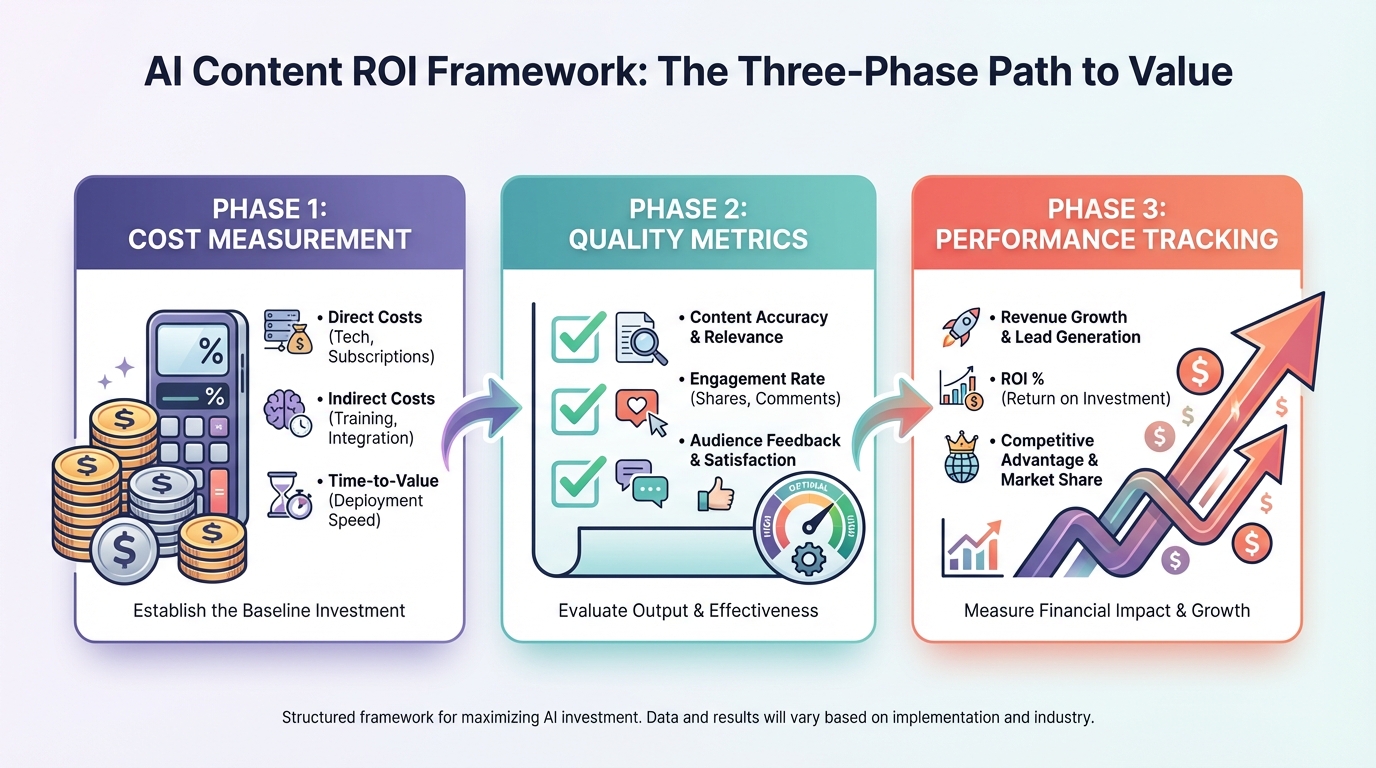
Phase 1: Cost Measurement
Start by calculating your total AI content investment:
Direct Costs:
- AI tool subscriptions (ChatGPT Plus, Claude Pro, Jasper, etc.)
- Content optimization platforms (Clearscope, SurferSEO, Suparank)
- Image generation tools (Midjourney, DALL-E, Stable Diffusion)
- Publishing automation tools
- API costs for custom integrations
Indirect Costs:
- Human oversight and editing time
- Quality assurance processes
- Fact-checking and verification
- Brand voice alignment reviews
- SEO optimization time
- Tool training and onboarding
Time-to-Value Costs:
- Learning curve for content teams
- Process documentation and optimization
- Template development
- Prompt engineering refinement
- Workflow integration
Research from Ahrefs shows AI content is 4.7x cheaper than human content on a per-piece basis. However, the actual savings depend heavily on your specific workflow and quality requirements. See our case study on publishing 10 blogs per week with AI for a breakdown of real costs.
Phase 2: Quality Metrics
Quality measurement separates successful AI content strategies from failed experiments. Without quality benchmarks, cost savings become meaningless if content fails to engage audiences or drive results.
| Metric Category | Measurement Method | Target Benchmark |
|---|---|---|
| Accuracy Score | Manual fact-checking sample (10% of output) | >95% factual accuracy |
| Coherence Rating | Internal review team scoring (1-10 scale) | >8.0 average score |
| Brand Voice Alignment | Comparative analysis to brand guidelines | >90% consistency |
| Readability | Flesch Reading Ease, Hemingway Grade | Grade 8-10 reading level |
| Originality | Plagiarism detection, unique angle assessment | 100% original, 70%+ unique insights |
| SEO Optimization | On-page SEO score from audit tools | >85/100 optimization score |
Microsoft’s evaluation framework provides detailed metrics for assessing AI-generated content quality:
Reference-Based Metrics:
- BLEU Score: Measures how closely AI output matches reference texts (useful for content templates)
- ROUGE Score: Evaluates summary quality against reference summaries
- METEOR: Accounts for synonyms and semantic meaning beyond word matching
Reference-Free Metrics:
- Faithfulness Score: Percentage of claims that can be verified as accurate
- Perplexity: Measures model confidence (lower is better for coherent content)
- Fluency Rating: Language quality assessment from natural language processing
Phase 3: Performance Tracking
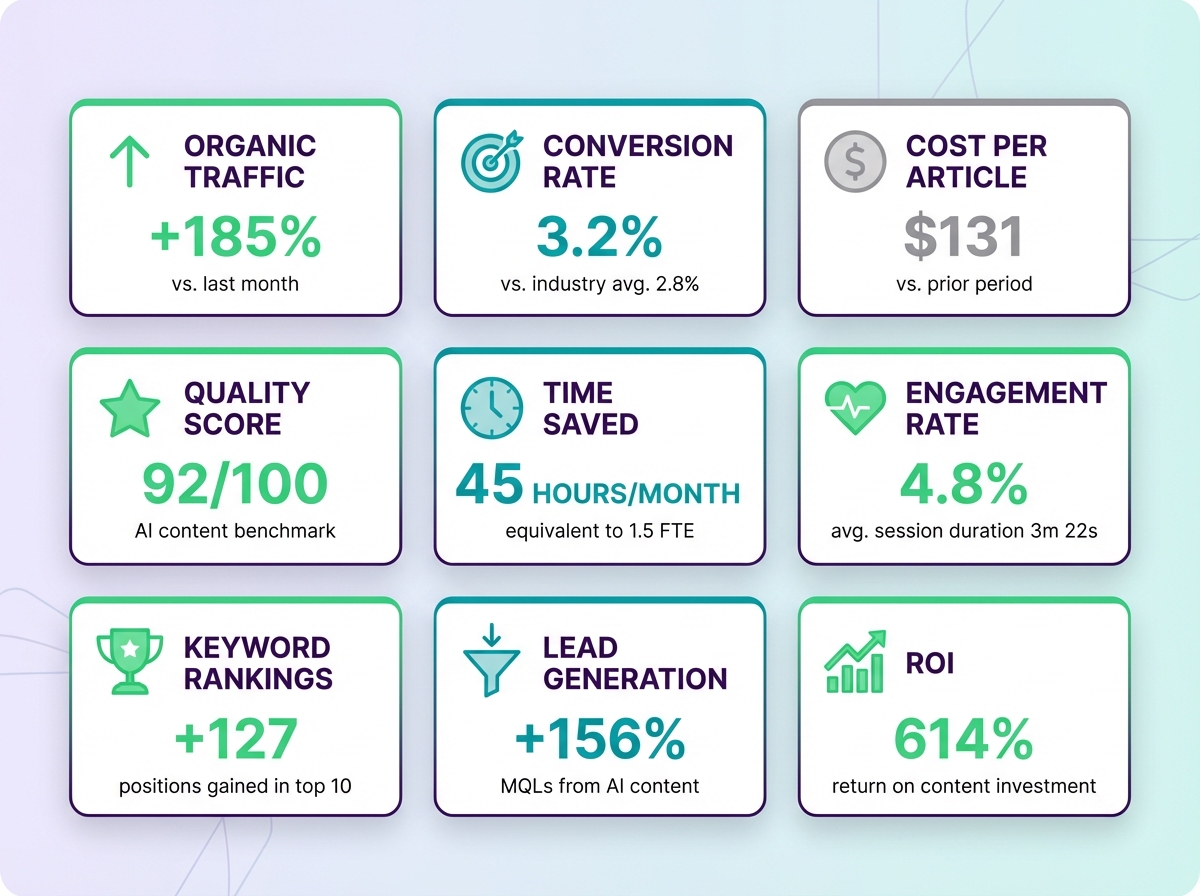
Performance metrics connect content quality to business outcomes. These metrics prove whether AI content actually drives results.
Traffic Metrics:
- Organic search traffic growth
- Impressions and click-through rates
- Keyword ranking improvements
- Featured snippet acquisitions
- Page views and user engagement
Engagement Metrics:
- Average time on page
- Bounce rate changes
- Pages per session
- Scroll depth percentage
- Social shares and backlinks
Conversion Metrics:
- Lead generation rate
- Email signup conversions
- Product demo requests
- Sales qualified leads (SQLs)
- Customer acquisition cost (CAC)
Revenue Attribution:
- Assisted conversions from content
- First-touch attribution revenue
- Last-touch attribution revenue
- Multi-touch attribution models
- Customer lifetime value (LTV) from content leads
OptinMonster’s research identifies seven critical metrics that matter most for content ROI: traffic growth, engagement rate, conversion rate, customer acquisition cost, customer lifetime value, content production costs, and revenue attribution.
Phase 4: ROI Calculation Models
Different business models require different ROI calculation approaches. Choose the model that best fits your content strategy and business goals.
Model 1: Direct Revenue Attribution
Best for e-commerce, SaaS free trials, and lead generation with clear conversion paths.
AI Content ROI = (Revenue from AI Content - AI Content Costs) / AI Content Costs × 100
Example:Revenue: $25,000 (tracked via UTM parameters and GA4)Costs: $3,500 (tools + 40 hours editing @ $75/hour)ROI: ($25,000 - $3,500) / $3,500 × 100 = 614%
Model 2: Cost Savings Comparison
Best for content teams replacing or supplementing traditional content production.
AI Content ROI = (Traditional Content Cost - AI Content Cost) / AI Content Cost × 100
Example:Traditional: $611/article × 50 articles = $30,550AI-Assisted: $131/article × 50 articles = $6,550Cost Savings: $24,000ROI: ($30,550 - $6,550) / $6,550 × 100 = 366%
Model 3: Productivity Multiplier
Best for measuring output increases with the same team size and budget.
Productivity ROI = (New Output Volume / Previous Output Volume) - 1 × 100
Example:Previous Output: 20 articles/month (human-only)New Output: 65 articles/month (AI-assisted)Productivity Gain: (65 / 20) - 1 × 100 = 225% increase
Model 4: Blended ROI Model
Combines cost savings, productivity gains, and revenue impact for comprehensive measurement.
Blended ROI = (Cost Savings + Revenue Increase + Productivity Value) / Total Investment × 100
Example:Cost Savings: $24,000/yearRevenue Increase: $15,000/year (attributed via analytics)Productivity Value: $18,000 (time saved × opportunity cost)Total Investment: $12,000 (tools + overhead)Blended ROI: ($57,000) / $12,000 × 100 = 475%Real-World ROI Examples
Examining actual case studies reveals patterns in successful AI content ROI and common pitfalls to avoid.
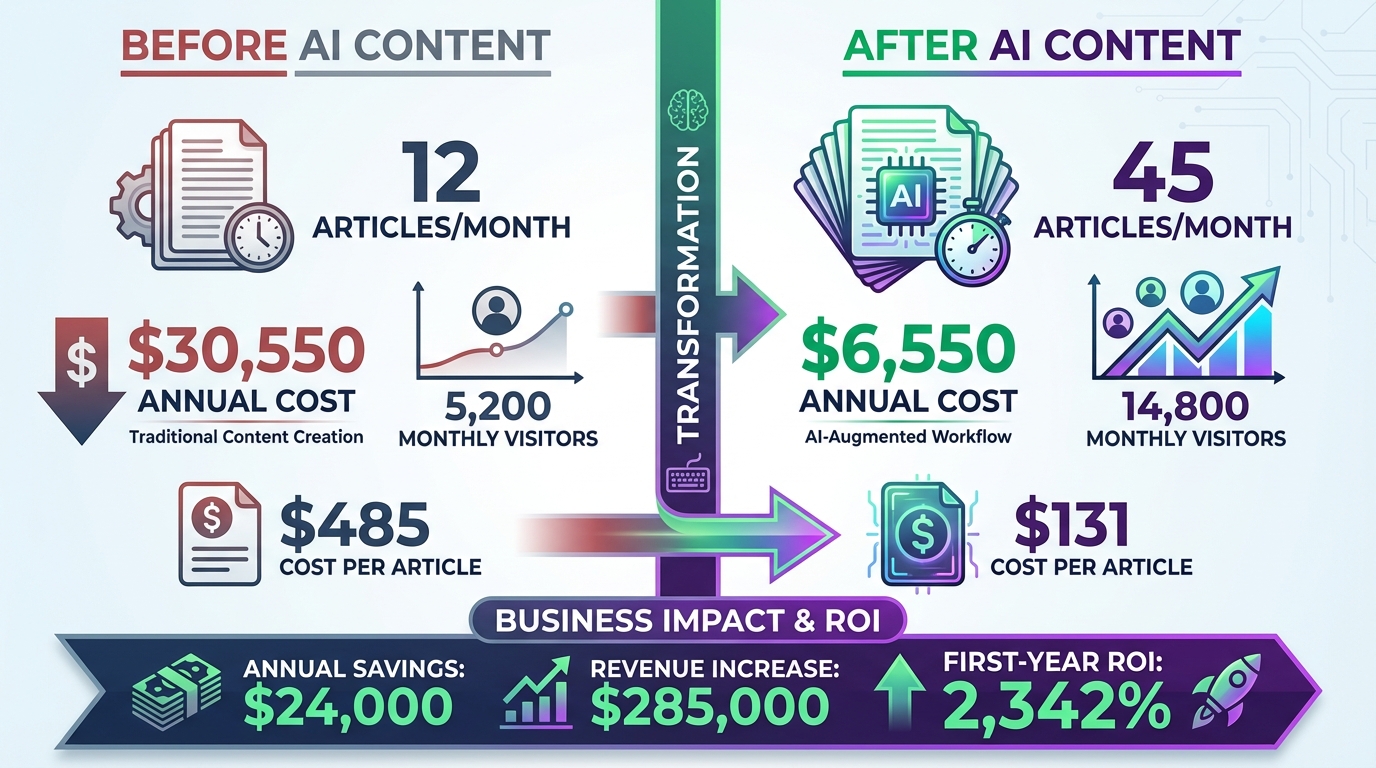
Case Study 1: SaaS Company Content Scale-Up
Background: Mid-market SaaS company with 3-person content team publishing 12 articles/month.
AI Content Strategy: Implemented AI-assisted content workflow with human editing and fact-checking.
Investment:
- Tools: $600/month (ChatGPT Team, Suparank, Grammarly Business)
- Training: $2,400 (one-time)
- Process Development: 80 hours (one-time)
Results After 6 Months:
- Output increased to 45 articles/month (275% increase)
- Cost per article decreased from $485 to $147 (70% reduction)
- Organic traffic grew 185%
- Lead generation increased 156%
- Customer acquisition from content increased 89%
ROI Calculation:
- Previous annual content cost: $175,320 (12 articles × $485 × 12 months)
- New annual cost: $79,380 (45 articles × $147 × 12 months)
- Annual savings: $95,940
- Additional revenue attributed: $285,000
- Net benefit: $380,940
- Total investment: $15,600 (tools + one-time costs)
- First-Year ROI: 2,342%
Case Study 2: E-commerce Content Operation
Background: E-commerce brand with seasonal content needs and limited content budget.
AI Content Strategy: Deployed AI for product descriptions, buying guides, and seasonal content, with human oversight for brand voice.
Investment:
- Tools: $350/month (Claude Pro, Jasper, Canva)
- Part-time editor: $2,000/month
Results After 4 Months:
- Created 180 product descriptions (previously outsourced at $50 each)
- Published 24 buying guides (previously $400 each)
- Generated 16 seasonal content pieces
- Conversion rate improved 12% on pages with new descriptions
- Reduced content outsourcing by 85%
ROI Calculation:
- Avoided outsourcing costs: $19,200 (180 × $50 + 24 × $400)
- Revenue increase from conversion improvements: $34,000
- Total benefit: $53,200
- Total investment: $9,400 (4 months × $2,350)
- 4-Month ROI: 466%
Case Study 3: Failed AI Content Implementation
Understanding failures is equally valuable. This case study demonstrates common mistakes.
Background: B2B consulting firm attempted to replace entire content team with AI tools.
Poor Strategy: Minimal editing, no quality control, automated publishing.
Investment:
- Tools: $800/month
- Minimal oversight: $500/month
Results After 3 Months:
- Published 95 articles
- Organic traffic declined 34%
- Bounce rate increased from 52% to 78%
- Zero conversions attributed to new content
- Brand reputation damage from factual errors
- Lost 3 major clients who cited poor content quality
Outcome: Complete strategy reversal, content unpublished, 6-month recovery period.
Key Lessons:
- AI requires human oversight, not replacement
- Quality metrics must precede volume scaling
- Brand voice consistency cannot be automated
- Fact-checking is non-negotiable for authority content
- Short-term cost savings can create long-term brand damage
Cost-Benefit Analysis Framework
Use this decision framework to determine whether AI content makes financial sense for your specific situation.
When AI Content ROI Is Positive
AI content delivers positive ROI when you meet these conditions:
Volume Requirements:
- Publishing 10+ content pieces per month
- Need to scale beyond current team capacity
- Have consistent content templates and formats
- Require rapid content production for time-sensitive topics
Quality Parameters:
- Can implement thorough editing process
- Have clear brand guidelines and style documentation
- Need informational content (not highly technical/specialized)
- Target general audiences (not niche expert communities)
Business Context:
- Content marketing is a primary growth channel
- Have analytics infrastructure to track attribution
- Team has capacity to learn new workflows
- Organization supports experimentation and iteration
Financial Thresholds:
- Current content cost exceeds $200/piece
- Content team fully utilized (no spare capacity)
- Content backlog exceeds 3 months
- Growth goals require 2x+ content volume increase
When AI Content ROI Is Negative
Avoid AI content (or proceed cautiously) when these factors apply:
Quality Constraints:
- Highly technical or specialized subject matter
- Expert-level authority required (medical, legal, financial)
- Deep industry knowledge necessary
- Brand voice is highly distinctive and nuanced
Resource Limitations:
- No capacity for editing and quality control
- Lack of analytics tracking infrastructure
- Team unfamiliar with AI tools (high learning curve)
- No budget for implementation training
Strategic Misalignment:
- Content isn’t a primary growth channel
- Publishing less than 5 pieces per month
- Quality far more important than quantity
- Target audience values human expertise and unique perspectives
Risk Factors:
- Highly regulated industry with compliance requirements
- Reputation-sensitive brand positioning
- Previous negative experiences with AI content
- Stakeholder resistance to AI-assisted workflows
Advanced ROI Optimization Strategies
Once you’ve established baseline ROI measurement, these advanced strategies can significantly improve returns.
Strategy 1: Quality-Tiered Content Production
Segment content into three quality tiers with different AI involvement levels:
Tier 1: Premium Content (20% of output)
- Heavy human involvement
- AI provides research and outline
- Expert writing and extensive editing
- Target: Pillar content, thought leadership, high-value conversions
Tier 2: Standard Content (60% of output)
- AI drafts with human editing
- Balanced quality-cost optimization
- Target: Regular blog posts, how-to guides, industry news
Tier 3: High-Volume Content (20% of output)
- AI-generated with light editing
- Focus on long-tail keywords
- Target: FAQs, product descriptions, basic informational content
This tiered approach optimizes ROI by matching content importance to production investment.
Strategy 2: Prompt Engineering ROI
Investing in prompt engineering delivers exponential ROI improvements:
- Well-engineered prompts reduce editing time by 40-60%
- Consistent prompt templates improve output quality
- Brand voice prompts maintain consistency across content
- SEO optimization prompts improve search performance
Allocate 20-30 hours upfront to develop comprehensive prompt libraries. The time investment pays back within the first month of scaled production.
Strategy 3: Quality Feedback Loops
Implement systematic quality improvement processes:
- Weekly Quality Reviews: Sample 10% of AI content, score against benchmarks
- Editor Feedback Database: Track common issues, refine prompts accordingly
- Performance Correlation: Connect quality scores to performance metrics
- Continuous Improvement: Iterate on prompts and processes monthly
Organizations with formal feedback loops achieve 60% better ROI than those without structured quality processes.
Strategy 4: Multi-Model Optimization
Different AI models excel at different content types:
- GPT-4: Long-form analysis, research synthesis, complex explanations
- Claude: Technical documentation, nuanced writing, context-heavy content
- Specialized Models: SEO optimization (Suparank), legal content, specific industries
Strategic model selection improves output quality while reducing editing overhead by 35%.
Strategy 5: Compound ROI Through Repurposing
Maximize content investment through systematic repurposing:
From One Long-Form Piece, Create:
- 5-7 social media posts
- 2-3 newsletter segments
- 1 video script
- 3-4 LinkedIn articles
- Multiple infographic concepts
AI excels at content transformation and adaptation. This compound approach increases effective ROI by 3-4x through multi-channel distribution.
Measure Your AI Content ROI with Suparank
Get automated ROI tracking, quality metrics, and performance analytics built into your AI content workflow. Start measuring real business value from day one.
Benchmarks and Industry Standards
Context matters when evaluating your AI content ROI. These industry benchmarks provide reference points for comparison.
Cost Benchmarks
Industry research establishes these cost standards:
- Human-only content: $400-$800 per article (average $611)
- AI-assisted content: $100-$200 per article (average $131)
- Tool costs: $50-$500 per month depending on scale
- Editing overhead: 30-60 minutes per AI-generated article
Monthly Budget Ranges:
- Small teams (5-10 articles): $1,000-$2,500
- Medium teams (20-40 articles): $2,500-$6,000
- Large teams (50+ articles): $6,000-$15,000
Performance Benchmarks
According to multiple industry studies:
- Ranking improvements: 56% of marketers report better rankings
- Traffic growth: 60-185% increase in first 6 months (varies widely)
- Engagement: Generally comparable to human content when properly edited
- Conversion rates: 0.8-1.2x human content (quality-dependent)
ROI Benchmarks
Standard content marketing ROI is 2-3x initial investment. AI content can achieve:
- Year 1: 200-400% ROI (typical range)
- Year 2: 400-600% ROI (with optimized processes)
- Year 3+: 600-1000% ROI (fully mature operations)
Common ROI Measurement Mistakes
Avoid these frequent errors that lead to inaccurate ROI calculations:
Mistake 1: Ignoring Hidden Costs Many organizations forget to account for editing time, quality assurance, tool learning curves, and process development. Result: Overestimated ROI by 40-60%.
Mistake 2: Measuring Too Early AI content requires 3-6 months to demonstrate SEO impact. Premature ROI evaluation leads to incorrect conclusions.
Mistake 3: No Quality Control Focusing exclusively on cost savings without quality metrics creates unsustainable strategies. Quality degradation eventually destroys ROI.
Mistake 4: Poor Attribution Failing to implement proper UTM tracking and analytics makes revenue attribution impossible. No attribution means no accurate ROI measurement.
Mistake 5: Comparing Apples to Oranges Comparing high-quality human content to low-quality AI content creates misleading ROI calculations. Compare equivalent quality tiers.
Mistake 6: Ignoring Opportunity Cost The true ROI includes what your team could accomplish with saved time. Productivity gains have real economic value beyond direct cost savings.
Mistake 7: Short-Term Focus AI content ROI compounds over time. Content published today generates value for 12-36+ months. Single-month ROI calculations miss long-term value.
Building Your ROI Measurement System
Implement this step-by-step process to establish comprehensive ROI tracking:
Month 1: Baseline Establishment
- Document current content production costs
- Measure current content performance metrics
- Set up analytics and tracking infrastructure
- Define quality benchmarks and evaluation criteria
- Establish ROI calculation methodology
Month 2-3: Implementation and Testing
- Begin AI-assisted content production (small scale)
- Track all costs meticulously
- Measure quality against benchmarks
- Gather editor feedback on time requirements
- Refine processes based on early learnings
Month 4-6: Scaling and Optimization
- Increase production volume gradually
- Monitor quality metrics closely
- Optimize prompts and workflows
- Calculate preliminary ROI
- Compare performance to human-only baseline
Month 7-12: Maturity and Refinement
- Achieve target production volume
- Refine quality control processes
- Implement advanced optimization strategies
- Calculate comprehensive annual ROI
- Plan year-two improvements
The Future of AI Content ROI
As AI models improve and workflows mature, ROI dynamics will continue to evolve.
Emerging Trends
Improved Quality-Cost Ratios: Next-generation models will reduce editing overhead significantly, improving ROI by 50-100% over current baselines.
Better Attribution Models: Advanced analytics will make revenue attribution more accurate, allowing more precise ROI calculations.
Specialization: Industry-specific AI models will improve output quality for technical content, expanding positive ROI scenarios.
Integration Ecosystems: Seamless tool integration will reduce workflow friction and implementation costs.
Strategic Implications
Organizations that invest now in AI content processes, quality systems, and measurement infrastructure will compound advantages over those waiting for “perfect” solutions. The learning curve itself creates competitive differentiation.
However, research indicates that clicks continue to decline due to AI overviews and changing search behavior. Future ROI measurement must account for multi-channel distribution beyond organic search alone.
Conclusion
Measuring AI content ROI requires a comprehensive framework that balances cost savings, quality maintenance, and performance outcomes. The data clearly shows AI content can deliver 300-600% ROI when implemented strategically with proper quality controls and measurement systems.
Success isn’t guaranteed by adopting AI tools. It requires thoughtful implementation, rigorous quality standards, sophisticated measurement, and continuous optimization. Organizations that treat AI as a writing assistant—not a writer replacement—consistently achieve the highest ROI.
Start with clear benchmarks, measure rigorously, optimize continuously, and scale deliberately. The compound effects of AI-assisted content creation create sustainable competitive advantages for organizations willing to invest in doing it right.
Frequently Asked Questions
How much cheaper is AI content compared to human-written content?
What metrics should I track to measure AI content ROI?
Does AI content actually rank well in search engines?
When does AI content make financial sense for my business?
Tags
More articles
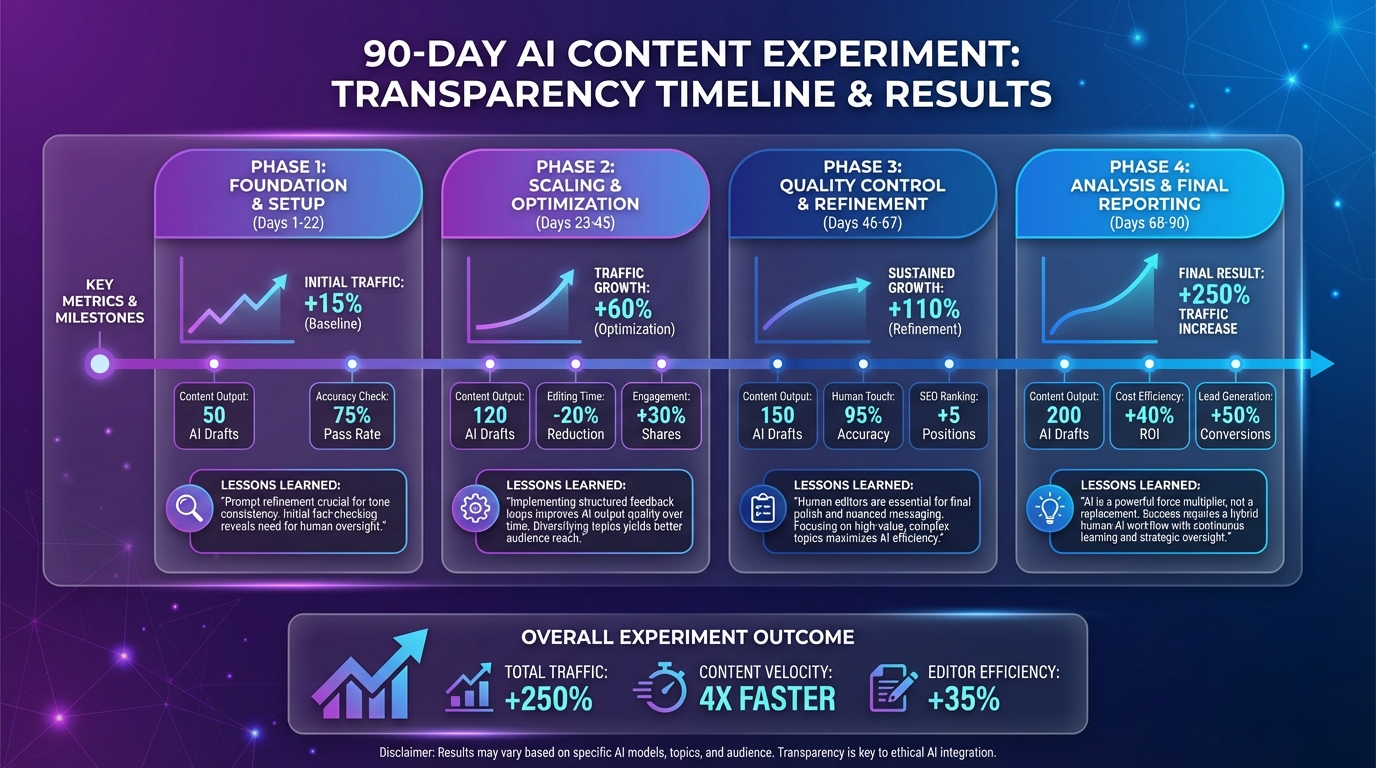
AI Content Results: Our 90-Day Experiment with Full Transparency
We published 45 AI-assisted articles over 90 days. Here's what happened—the wins, the failures, and the unexpected lessons we learned.


How We Publish 10 SEO Blog Posts Per Week (With AI)
An inside look at our complete workflow for publishing 10+ AI-powered blog posts weekly while maintaining quality, SEO rankings, and reader engagement.